This video points out the power of weather on commodity markets. How can you potentially profit using the weather in your investment portfolio?
(click below)
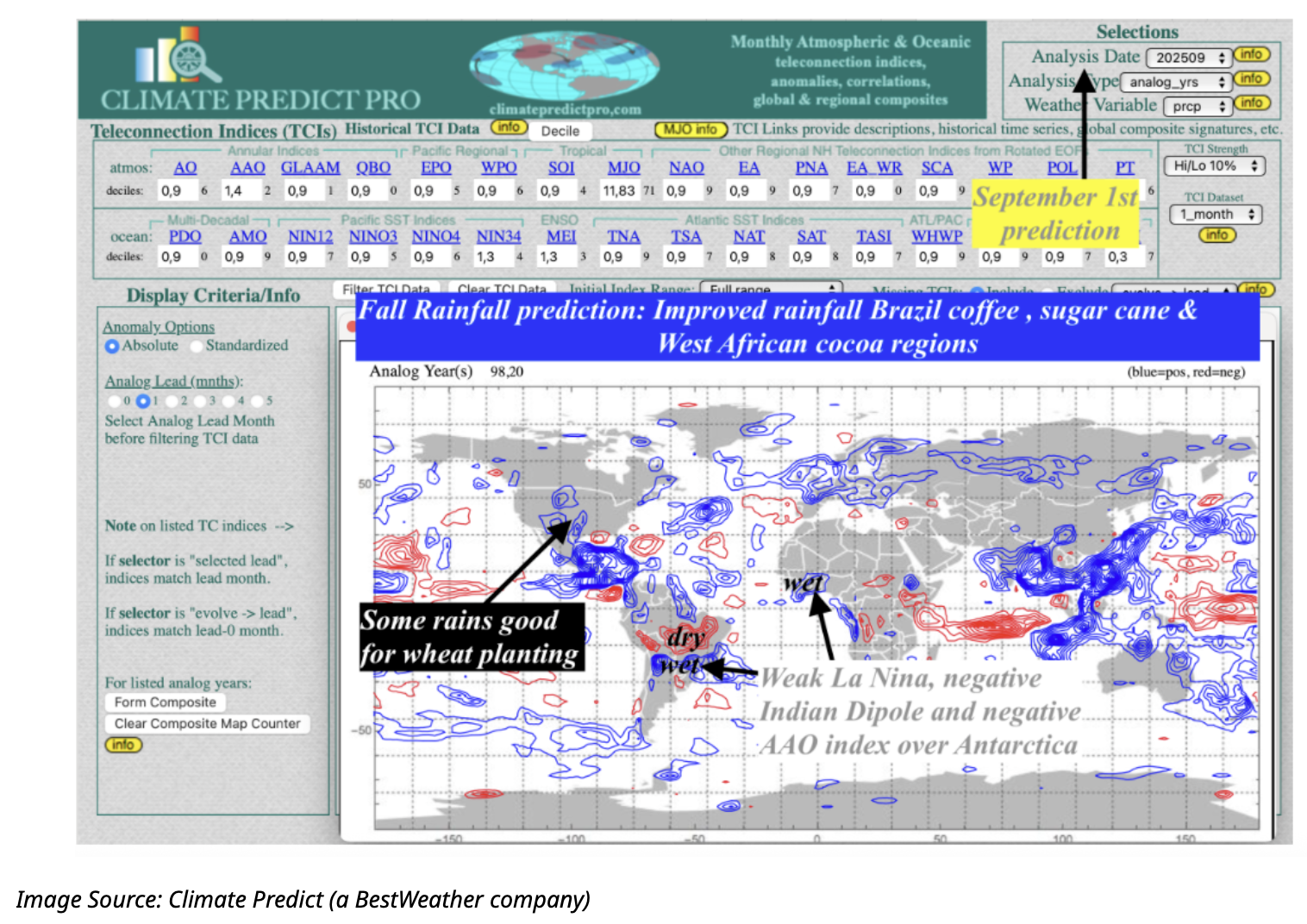
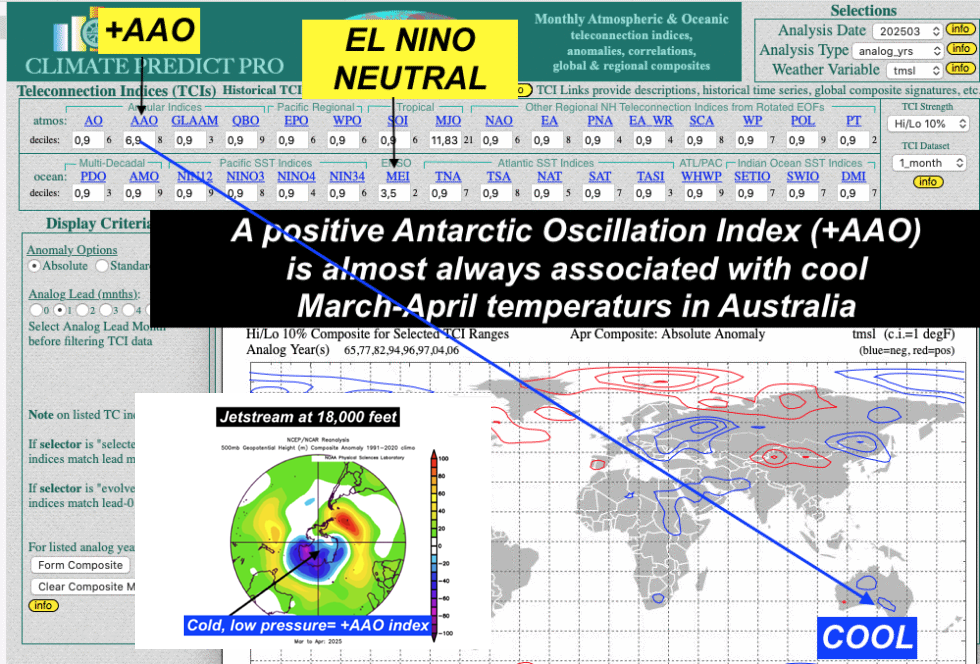
Most recently, a developing La Niña event combined with a negative Indian Ocean Dipole in the Pacific and a weak negative Antarctic Oscillation Index is causing bear markets in cocoa and sugar. Coffee prices may be next (especially if trade tariff tensions ease with Brazil), as we have been predicting the end of Brazil’s multi-year drought for two months.
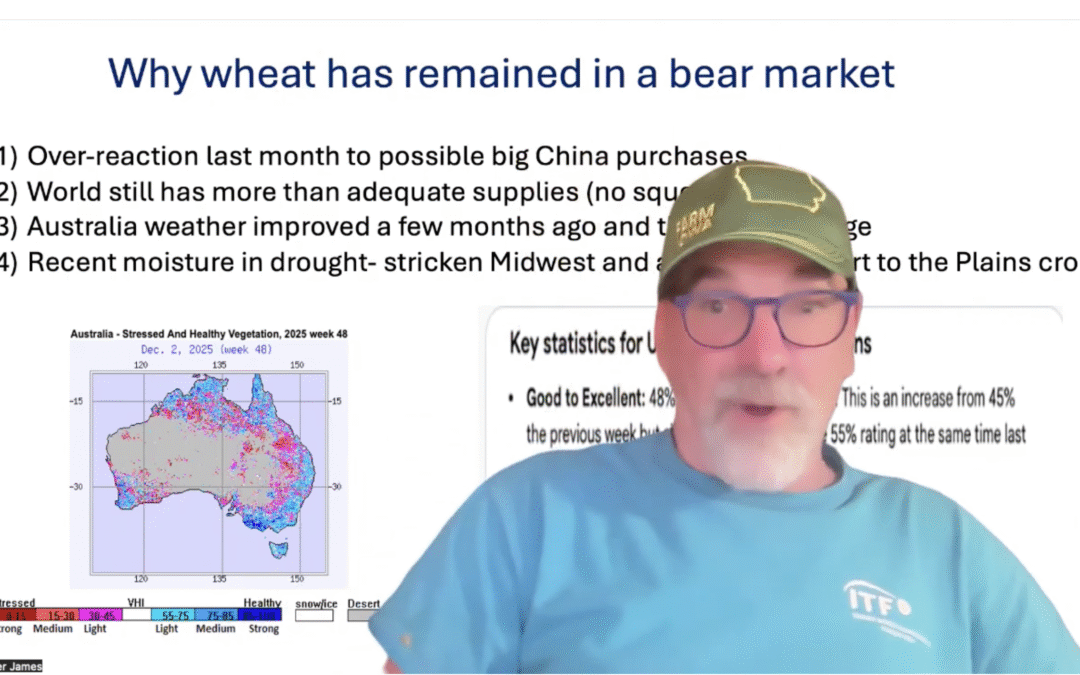
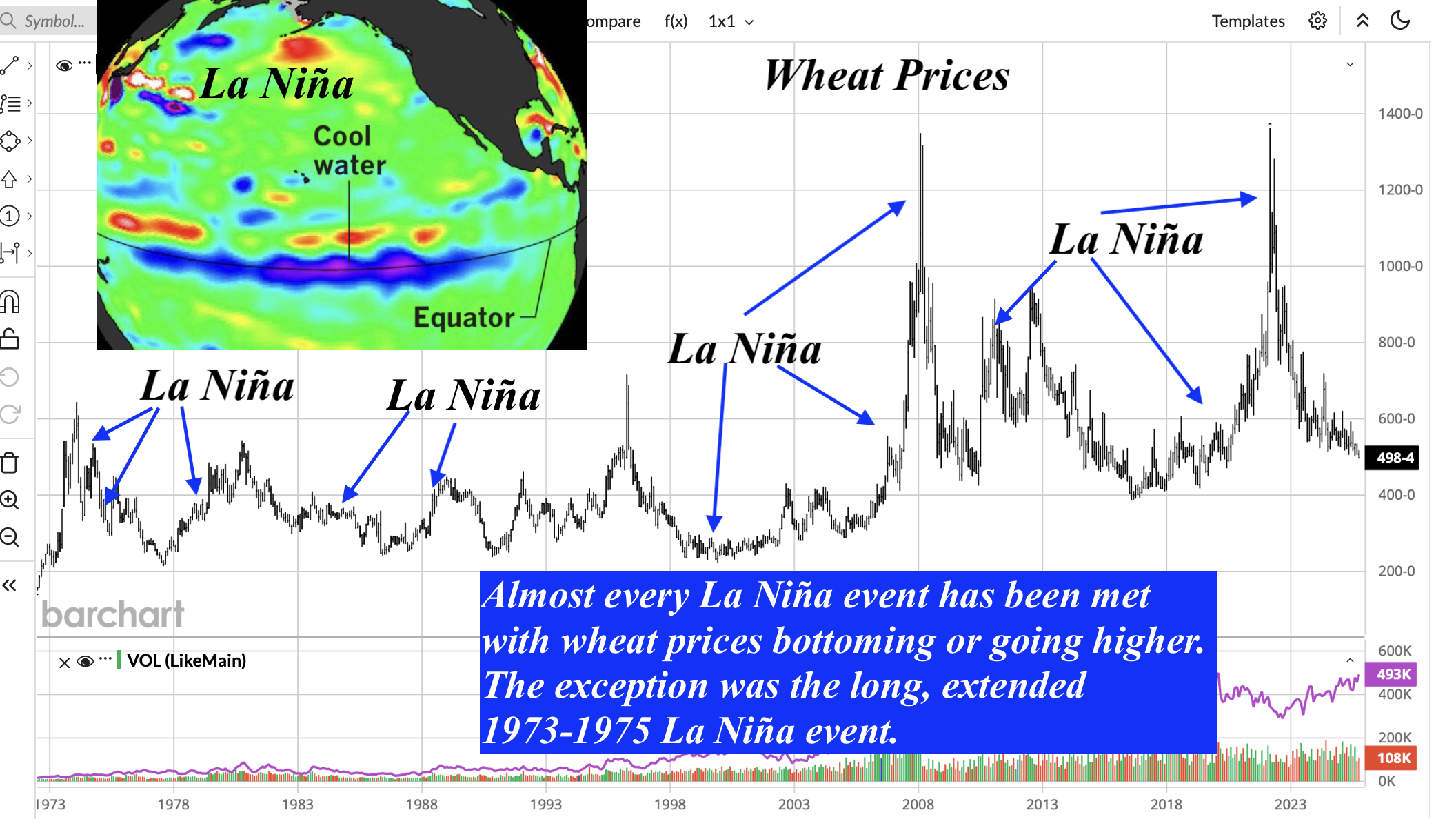
In addition, the rains in Australia and generally good global wheat crops have kept the wheat futures markets in a downtrend. Could that change next year with La Niña?
Screenshot
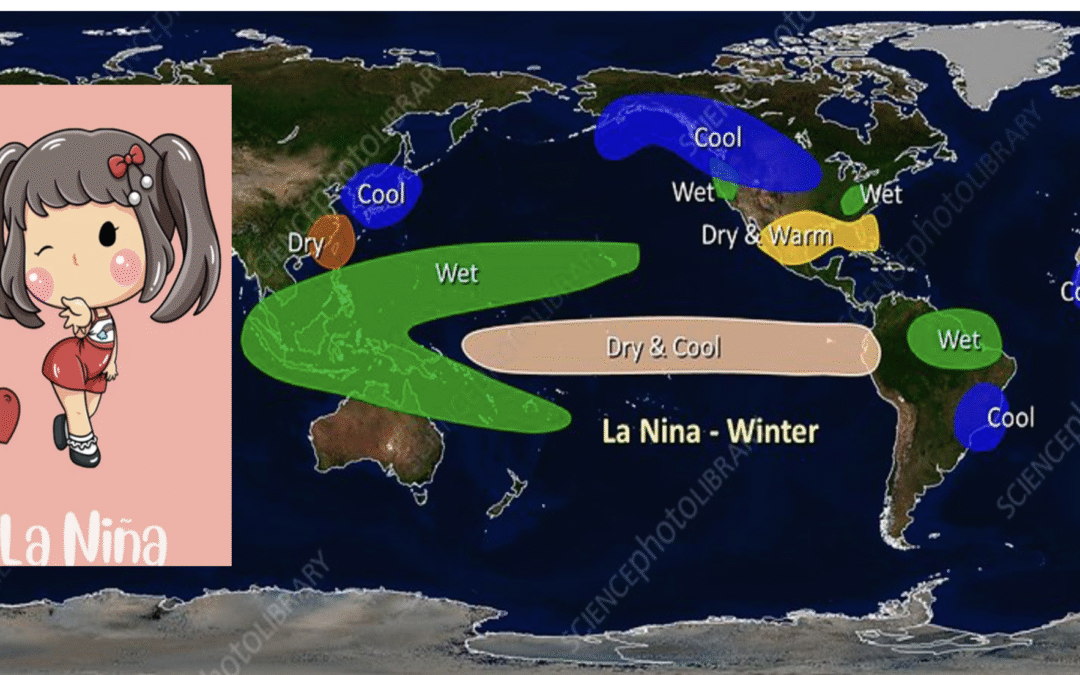
While the grain market has been hurt by more record global crops, trade tariffs, and poor demand, could La Niña end the bear market by 2026? It is possible.
The US corn crop has come down from a dry late summer and disease issues, and may be the one lone bullish Ag star after the US grain harvest.
You can now receive occasional free weather and commodity discussions on SUBSTACK (click below)
For specific trading and hedging strategies and much more frequent commodity weather ideas, and our BestWeather Spiders for all commodities:Click here for a two week FREE TRIAL for $1
Once your free trial ends to WeatherWealth ($1), you are eligible for a 70% annual discount for over 100 issues. Click below
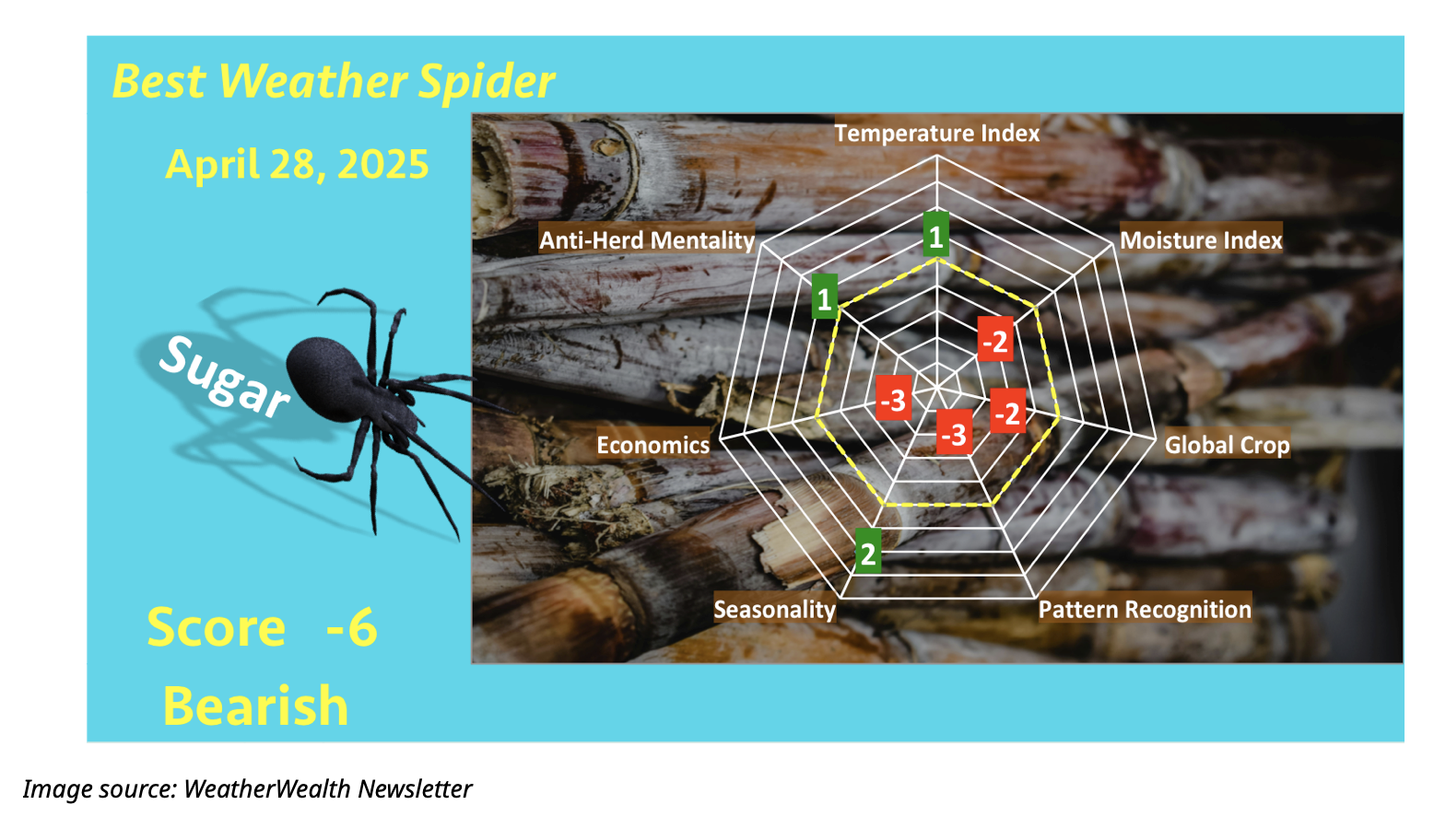
The BestWeather Spider is considered a reliable tool for commodity traders because it integrates advanced weather forecasting (including factors like El Niño, La Niña, and the Indian Ocean Dipole) with market analysis to anticipate how weather events will impact commodity prices.
Screenshot
Jim Roemer’s approach uses both meteorological data and market fundamentals, providing actionable insights that help traders and farmers make informed decisions in volatile markets.The Spider’s recommendations are regularly updated in the WeatherWealth newsletter, which further enhances its reliability through continuous analysis and expert commentary.
Jim Roemer’s BestWeather Commodity Spider is a proprietary tool that combines weather analysis, technical analysis, and other market fundamentals to help commodity traders anticipate price movements in markets like grains, energy, and soft commodities. The Spider provides actionable insights by showing how weather patterns and forecasts may impact specific commodities, giving both experienced and novice traders an edge in making informed trading decisions. It is part of the broader suite of services offered by Best Weather Inc., which includes newsletters and reports with trade recommendations based on meteorological data and market analysis.
Jim Roemer’s BestWeather Commodity Spider predicts market moves by integrating several key factors:
Weather analysis: It assesses global weather patterns—such as El Niño, La Niña, droughts, and temperature anomalies—that can impact crop yields and energy demand
Technical analysis: The Spider incorporates chart patterns and market signals to identify trends or reversals in commodity prices.
Market fundamentals: It evaluates supply and demand factors, currency movements, and geopolitical events that influence commodity markets
Market psychology: The tool interprets trader sentiment and behavioral patterns to anticipate potential market reactions.
By combining these elements, the Spider provides actionable insights and trade ideas for commodities like grains, energy, coffee, and cocoa, helping traders anticipate and respond to market shifts
The Indian Ocean Dipole (IOD) is a climate phenomenon affecting the Indian Ocean. During a positive phase, warmth is pushed to the Western part of that body of water, while cold deep waters are brought up to the surface in the eastern end of the Indian Ocean. This pattern is reversed during the negative phase of the IOD. It is also known as the Indian Niño, as it draws similarity with the El-Niño Southern Oscillation (ENSO).
What are we looking at?
The plot tracks the conditions in the Indian Ocean, showing the phase of the IOD both now and in the past. Right now we are in a negative phase.
When the value of the time series is positive (red shading), the warm phase of the IOD is present with higher sea level in the western Indian Ocean and lower sea level in the eastern Indian Ocean.
When the value is negative (blue shading on graph above), the cool phase of the IOD is present with lower sea level in the western Indian Ocean and higher sea level in the eastern Indian Ocean. This is what we have today.
Why is it important in commodity trading?
The IOD influences tropical commodities in Africa, Australia and Southeast Asia the most.
During the positive phase of the IOD, the high temperatures along the coast of Africa cause heavy rains and droughts in Australia.
During a negative phase the high temperatures and rainfall patterns are reversed. The sea-level changes associated with the IOD can also lead to increased threats of coastal flooding and associated impacts. However, for west Africa, a negative IOD phase coupled with an El Niño can bring bull markets for cocoa with dry spring and summers often occurring affecting the main crops in Ivory Coast and Ghana.
Presently, we have an El Niño neutral situation and a developing negative Indian Dipole. Hence, the situation is a bit confusing, but could portend a decent (not great) main cocoa crop and possibly take the steam out of the recent two year bull market.
Source: Jim Roemer (Climatepredict software): “If there was an El Niñno in 2025, which there is not, drier weather and a potential bull market would occur this summer“
The negative phase of the IOD brings about the opposite conditions of a positive IOD, with warmer water and greater precipitation in the eastern Indian Ocean, and cooler and drier conditions in the west.
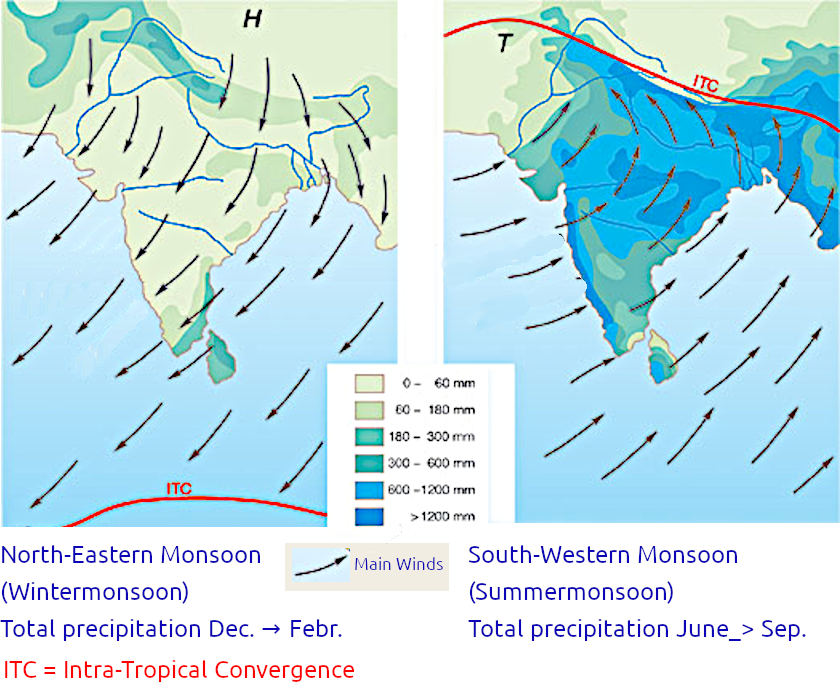
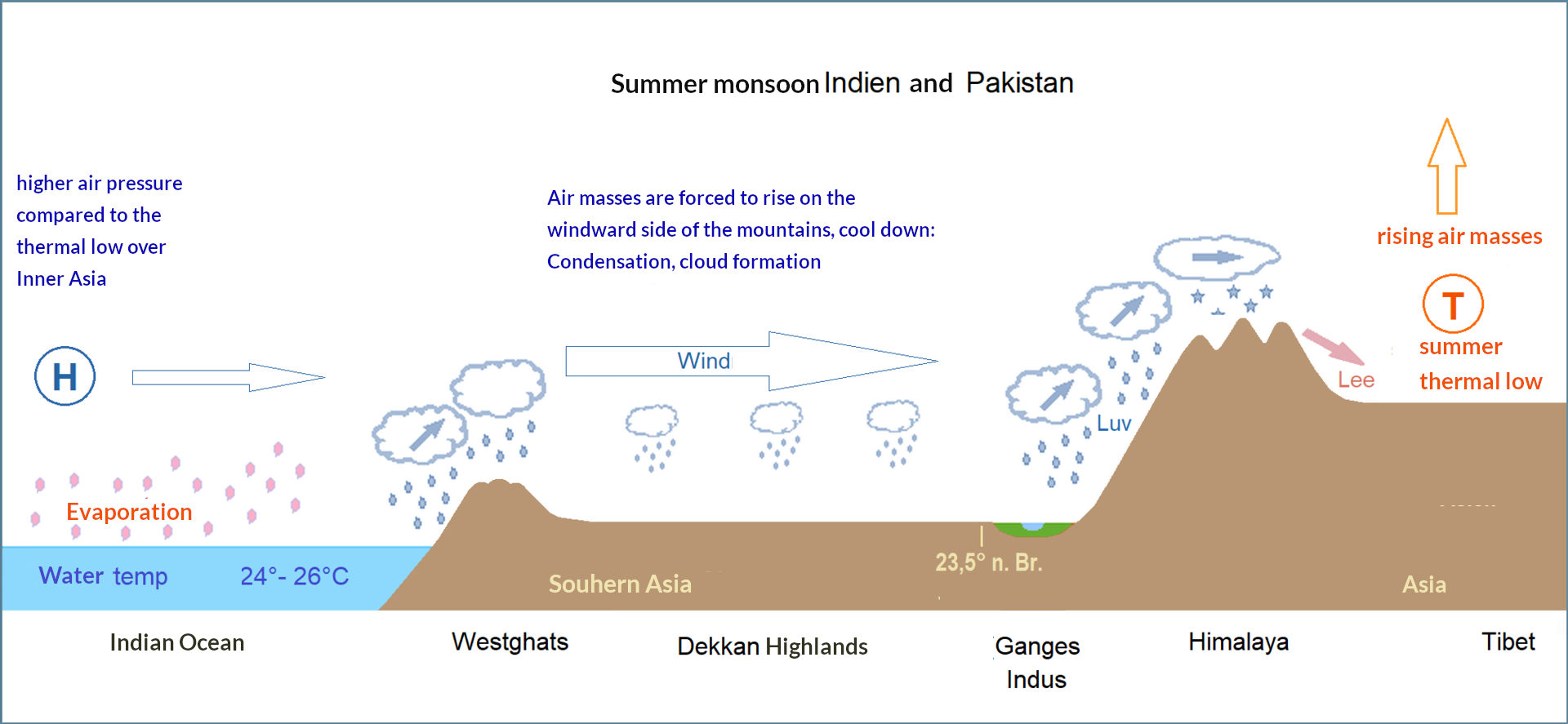
The IOD also affects the strength of monsoons over the Indian subcontinent. This is what we have presently: A negative Indian Ocean Dipole, whose effects should be for a general good monsoon in India that tends to be bearish commodities such as sugar.
The impact of monsoons on Indian farmers
A majority of India’s GDP is dependent on the growth and production of agriculture. India is an agrarian nation, with more than 50% of the population earning their livelihood in agriculture.
The monsoon is the most important season for farmers in this country. A majority of Indian agricultural land is watered by the southwest monsoon. Field crops such as sugar, cotton, wheat, rice, and legumes are staple foods in India. They require strong rainfall in order to grow.
Does the Indian Monsoon affect summer corn belt weather?
There is only a little evidence that the Indian monsoon has a significant or consistent effect on Midwest Corn Belt weather. The Midwest’s weather and crop yields are primarily influenced by local factors such as precipitation recycling, land use, and groundwater, as well as larger-scale patterns like El Niño and La Niña. While global weather systems can sometimes interact, and changes in major monsoon systems may have indirect or minor effects on global atmospheric circulation, any direct linkage between the Indian monsoon and Midwest Corn Belt weather is not established in the search results.
You can see on my ClimatePredict program below (available to subscribers to WeatherWealth newsletter), there is a slight (-.31) correlation of the Indian Dipole and July corn belt rainfall.
In other words, a negative IOD, which is negatively correlated, suggests a slight chance for above normal corn belt rains (two negatives = a positive value). Notice, however, the correlation is much higher with El Niño/La Niña (+1.01). An El Niño (warm ocean signal) is positively correlated with corn belt rain. In other words wet, while La Niña is the opposite– a dry bullish signal like 2011 and 2012. Right now, we have mixed “El Niño neutral” conditions.
July temperature tends to to be hotter than normal for the Midwest corn belt with a negative IOD. Here too, the correlation is much weaker with the IOD than El Niño/La Niña and other teleconnections
Conclusion:
It promises to be another wild summer for the grain market, as the potential for hot summer weather will increase market volatility. The Indian Ocean Dipole being negative and an “El Niño neutral” event does suggest that most (not all) of the Midwest grain belt should have decent summer rains.
With respect to soft commodities, potential crop problems may continue for parts of West African cocoa, while Robusta coffee and sugar crops recover in Southeast Asia. This could keep these two commodities in a more longer term bear market. Of course, the behavior of the Brazilian Real, US dollar and crops in various locations will also play a role.
by Jim Roemer – Meteorologist – Commodity Trading Advisor – Principal, Best Weather Inc. & Climate Predict – Publisher, Weather Wealth Newsletter
Scott Mathews, Editor
Weekend Report – May 9-11, 2025
Source: Screenshot by Climate Predict LLC – superimposed comments and markers by BestWeather – insert of Pacific Walker Circulation image by NOAA
While the grain futures have been mostly in a bear market, even with a weaker dollar, commodities from gold to cocoa and coffee continue in bull trends. Canola prices have really been perking up.
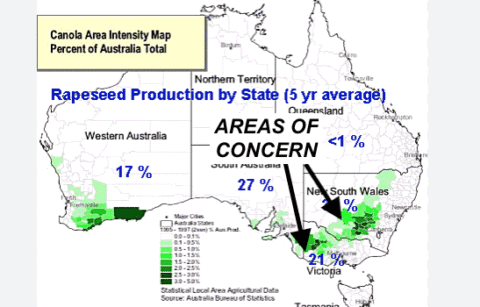
Potentially, there is a global weather problem as the drought in China is beginning to affect some crops in parts of southern Australia.
Below, I discuss how weather and the El Niño neutral stage (neither El Niño or La Niña) is affecting every commodity from wheat to ideal Midwest corn belt weather, previous crop problems in West African cocoa and why global sugar weather is improving. How about natural gas and a possible hot summer?
As a WeatherWealth newsletter subscriber, not only do you receive trading ideas, but you also see much more accurate weather information as we “second guess” standard weather models by looking at these 28 global weather teleconnections for all Ag and natural gas commodities.
—Enjoy Jim Roemer
Source: map by USDA
– commentary and indicator arrows added by BestWeather
Source: price graph by Barchart.com
– indicator arrow and superimposed wording by BestWeather
Source: screenshot by Climate Predict LLC
Source: screenshot by Climate Predict LLC with comments and indicator arrows superimposed by BestWeather
Source: map by Agri-Food Canada (a national information service)
Source: maps by stormvistawxmodels.com – used by permission- superimposed comment and indicator arrow by BestWeather
Source: map by WeatherBELL – used by permission
Sources: three screenshots above by Climate Predict LLC
– superimposed comments and indicator arrows by BestWeather
– antarctic polar projection map insert by NOAA, with superimposed markers by BestWeather
Source: maps by USDA, with indicator arrow superimposed by BestWeather
Source: map by WeatherBELL – used by permission
Source: maps by NOAA with superimposed labels and comments by BestWeather
Source: map by NOAA with superimposed arrow indicator by BestWeather
Sources: seasonality table by MRCI (used by permission), with superimposed elements by BestWeather- Map by stormvistawxmodels.com – used by permission – comments and indicators by BestWeather
Source: BestWeather Spider – royalty free natural gas flair photo by pexels.com
Artwork created via AI software DALL-E 3 and is the property of BestWeather
Thanks for your interest in commodity weather!!!
Mr. Roemer owns Best Weather Inc., offering weather-related blogs for commodity traders and farmers. He also is a co-founder of Climate Predict LLC, a detailed long-range global weather forecast tool. As one of the first meteorologists to become an NFA registered Commodity Trading Advisor, he has worked with major hedge funds, Midwest farmers, and individual traders for over 35 years. With a special emphasis on interpreting market psychology, coupled with his short and long-term trend forecasting in grains, softs, and the energy markets, he commands a unique standing among advisors in the commodity risk management industry.
This article contains syndicated content. We have not reviewed, approved, or endorsed the content, and may receive compensation for placement of the content on this site. For more information please view the Barchart Disclosure Policy here.
click on video below of renowned meteorologist and commodity investing analyst Jim Roemer riding out the hurricane in Sarasota.
Windows being blown out of building and trees down. However, the situation for this area could have been a lot worse if Milton did not weaken at landfall. Though NOAA and others are saying it landed as a CAT 3 hurricane, sustained winds of around 80-90 MPH with gusts to 100 or so, was really a strong Cat 2. A big difference, though certainly many communities around Tampa, etc. had severe flooding. Tornadoes were the biggest threat in Florida (a record number)
HELPING YOU MAKE THE BEST INVESTMENT DECISIONS BASED ON THE WEATHER
We use cookies to ensure that we give you the best experience on our website. If you continue to use this site we will assume that you are happy with it.