This video by Jim Roemer discusses the potential winter weather forecast:
1) How strong LNG exports and “feed gas” demand previously helped natural gas prices rally to over $4.00
2) How Jim called the top in the market 1-2 weeks ago, as trader sentiment always shifts to weather and the shoulder month comes in mid-October
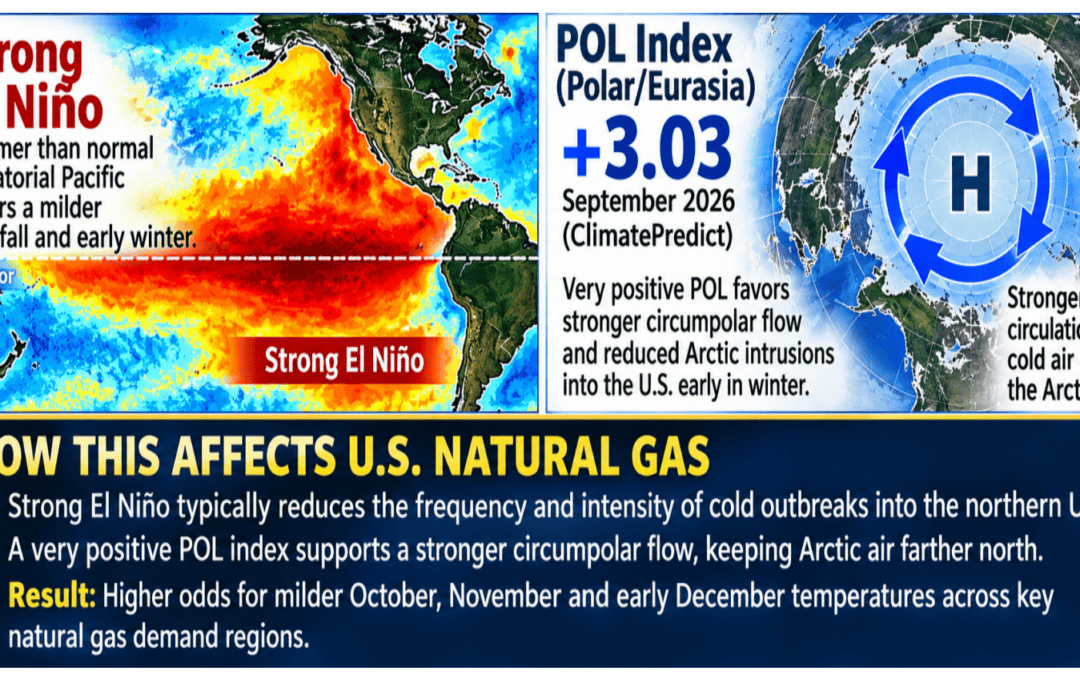
3) What is the POL index? Its positive nature means the polar vortex could stay well north of the U.S. most of this winter
4) Our initial (winter weather forecast) December temperature outlook. If this verifies, natural gas prices could fall below $3 in the winter contracts
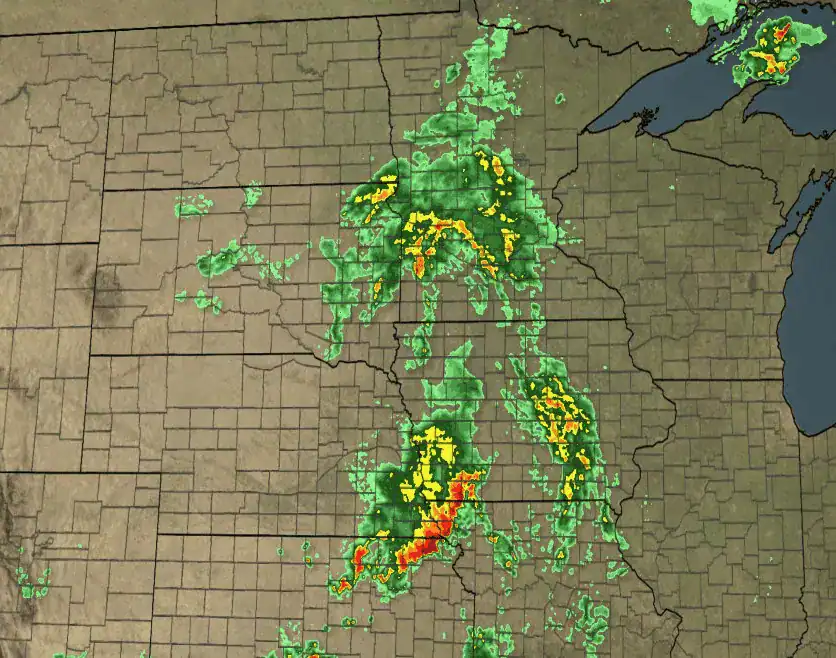
El Niños plot twist: Forget the drought – Now it’s the water: From a hurricane near Hawaii and a major East Coast Nor’easter to soaking rains in the Plains and Brazil, excessive moisture is becoming the new weather story for commodity markets. It will even turn a bit too wet for the corn and soybean harvest in much of Iowa, parts of Illinois, Nebraska, Minnesota and Missouri next week.
By Jim Roemer — Meteorologist/Commodity Trading Advisor Climatelligence & WeatherWealth
For months, traders have associated the developing powerful El Niño with the usual buzzwords: drought, heat and crop stress.
But Mother Nature apparently misplaced the script.
As we head into the final weekend of September, some of the most important weather stories around the world aren’t about drought at all.
They’re about too much water.
And that distinction could become increasingly important for everything from coffee and sugar to wheat and cotton, while millions of Americans deal with an unusually stormy pattern.
🌊 From Hawaii to New England: El Niño Flexes Its Muscles
Consider the extraordinary contrast between the Pacific and Atlantic hurricane seasons.
While the Atlantic has yet to produce a hurricane this season—an exceptionally unusual situation this late in September—the eastern and central Pacific have already produced nine hurricanes, including five major hurricanes.
Now Hurricane Nolo is south of Hawaii.
As of Thursday evening, Nolo had strengthened to a hurricane with sustained winds near 75 mph, about 255 miles south of South Point on the Big Island. I have warned of the potential for life-threatening to catastrophic flash flooding on the Big Island into the weekend.
That is classic El Niño geography: Pacific tropical activity becomes much more important while Atlantic activity can be suppressed by stronger upper-level winds.
But thousands of miles away, another storm is stealing the headlines.
🌧️ A September Nor’easter for Millions of East Coast Residents
A powerful, slow-moving coastal storm is developing along the East Coast.
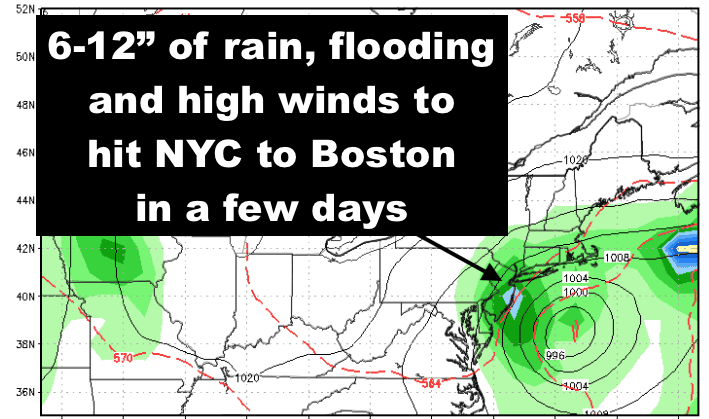
I predict the Nor’easter to linger near the northern Mid-Atlantic and Northeast coast through the weekend and into early next week, producing heavy rain, strong winds, coastal flooding, beach erosion and dangerous surf.
Check out this weather map for early Sunday a.m.
Source:Stormvistamodels and WeatherWealth newsletterThis isn’t necessarily a quick Saturday rainstorm.
It may sit and spin.
From New Jersey and Long Island into Connecticut, Rhode Island and Massachusetts, millions of residents could experience a prolonged period of miserable weather.
Some forecasts suggest 2–4 inches of rain from portions of New Jersey northward, with localized totals of 4–6 inches around Long Island and the Boston area, while coastal New England could experience wind gusts over 50 mph.
The bigger problems may ultimately be flooding, power outages, coastal erosion and transportation headaches rather than simply the rainfall totals.
So while much of the Atlantic hurricane season has been remarkably quiet, the atmosphere has found another way to create havoc.
El Niño doesn’t mean “no storms.” It often means the storm tracks get rearranged.
🌾 Plains Wheat: Finally, the Rain Farmers Have Been Waiting For
Now let’s move from weather inconvenience to commodity opportunity.
One of the most dramatic changes is occurring across the Texas Panhandle, Oklahoma Panhandle and western Kansas.
These areas desperately needed moisture heading into winter wheat planting.
Kansas State University reported recently that 91% of Kansas was abnormally dry or worse, leaving many producers wondering whether they would have to “dust in” wheat seed and wait for rain.
Suddenly, the pattern has flipped.
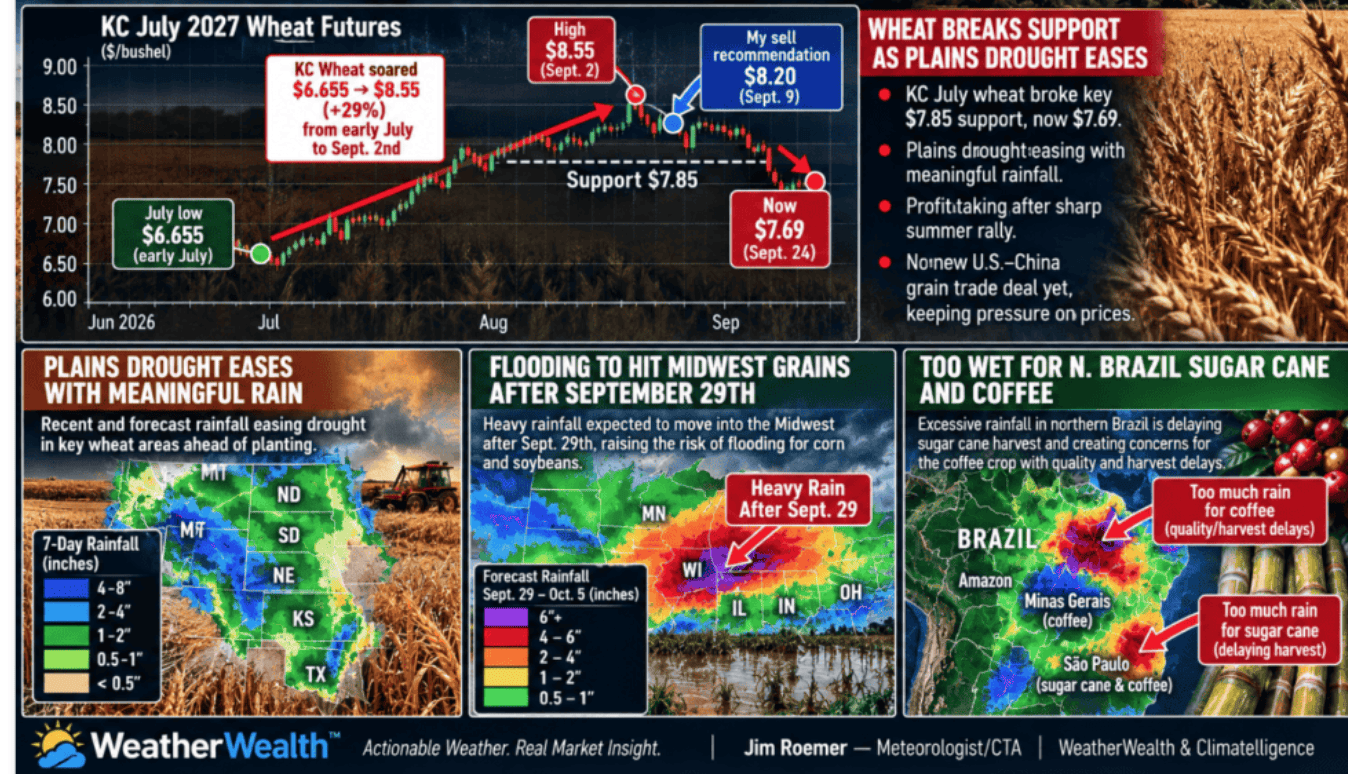
Parts of western Kansas and the Texas/Oklahoma Panhandles have already received several inches of rain, and additional wet weather is possible. The Weather Prediction Center reported areas receiving another 1.5–2.5 inchesafter earlier 2–3″+ totals, noting that most of the precipitation would be beneficial despite localized flash-flood concerns.
In some locations, rainfall during this wet cycle may amount to roughly 200–400% of normal.
For winter wheat, this is potentially excellent news. Trading wheat on my prediction two weeks ago was one of my highest confidence recommendations in the “paid subscription section of my newsletter below.”
This one trade alone already paid for 7 years to a subscription to Climatelligence since early September’s wheat trade recommendation, alone.
Instead of planting wheat into powder-dry soil, farmers may suddenly have something they haven’t enjoyed consistently in years:
A legitimate moisture profile for germination and establishment.
That could improve emergence and early root development and reduce one of the important weather premiums that helped support Kansas City wheat prices earlier this summer.
👕 Cotton: The Same Rain Can Be Bad News
Here is where commodity weather becomes fascinating.
The exact same rain that helps wheat can hurt cotton.
West Texas cotton has spent much of the growing season battling drought. Earlier rainfall would have been welcomed.
But late September is different.
Cotton is approaching maturity and harvest. Persistent heavy rain can interfere with boll opening and defoliation, slow harvest, reduce fiber quality and—if accompanied by wind—knock open cotton from plants.
So the commodity-weather equation has suddenly become:
WHEAT: 🌧️ Rain = mostly beneficial
COTTON: 🌧️ Too much rain = potentially bearish for crop quality and harvest
One storm system. Two crops. Completely different consequences.
That is why simply saying “rain is bullish” or “rain is bearish” is one of the biggest mistakes commodity traders can make. Timing matters as much as rainfall totals.
☕ Brazil Sugar & Coffee: From Perfect Flowering Rain to Too Much of a Good Thing?
Brazil provides an even better example.
September rains initially looked like exactly what coffee producers wanted.
After the dry season, rainfall stimulates flowering for the 2027 coffee crop.
But the rains have become increasingly persistent in important areas of Minas
Gerais and São Paulo.
However, I am going against the crowd. I have warned that rain could interfere with the final stages of the old coffee harvest and drying operations.
More recently, producers reported that wet weather was delaying the collection of coffee still on the ground just as the new flowering cycle was beginning.
And now another concern is developing.
What happens if it keeps raining?
The Cerrado Mineiro harvest is roughly 99% complete, but recent rain and hail have increased concerns about diseases including phoma and bacterial infections in affected areas.
That does not mean Brazil suddenly has a coffee crop disaster. Far from it.
The early bloom may ultimately prove beneficial.
But persistent excessive moisture following flowering can raise disease pressure and complicate fruit setting. The next several weeks could therefore become far more important for coffee traders than the impressive early flowering photographs circulating around the market suggest.
The coffee story may be shifting from “great rains for flowering” toward “how much rain is too much?”
I advised farmers and traders to sell wheat. As of this writing early Friday a.m. the trade is ahead $2,000 a contract. Put protective stops in if you sold wheat in my advice in the last week or two to preserve $1,000 or more profits, so you do not lose
I also like the sugar ETF (CANE) and long March, 2027 $6000 cocoa calls.
I also have some new information about the coffee, grains and natural gas but that is in my WeatherWealth premium newseltter
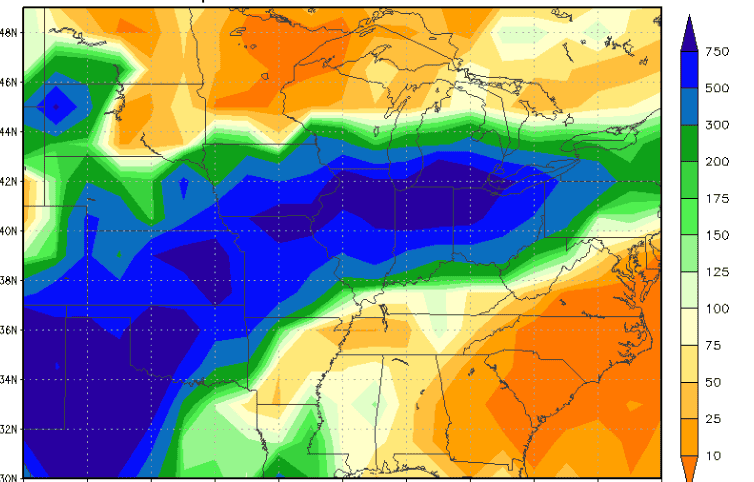
Finally, rainfall could exceed 200-300% in parts of the Midwest corn and soybean belt (blue) for about a week delaying the harvest next week.
Editor-in-Chief and Co-Producer of Climatelligence
August 12, 2026
Source: Jim Roemer – Meteorologist – Commodity Trading Advisor – Principal, Best Weather Inc. & Climate Predict – Publisher, Weather Wealth Newsletter and Co-Producer of Climatelligence
Special Report
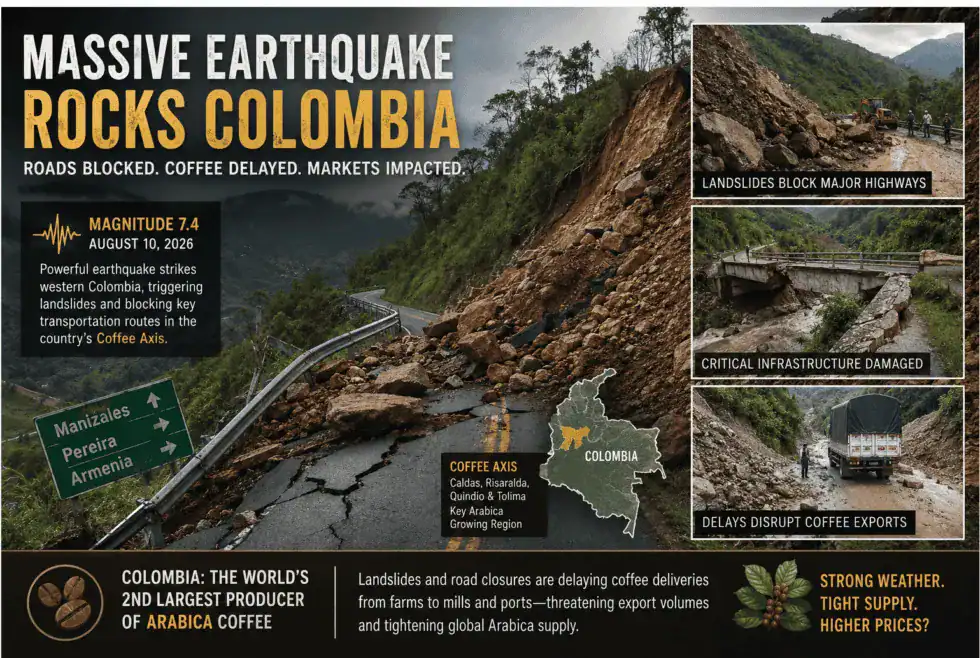
Colombia plays a key role in the global coffee market through its high-quality production of colombian coffee.
More importantly, though, Columbia ia the second-largest producer of arabica coffee after Brazil. Colombian production is almost entirely arabica, so disruptions there can have a disproportionate effect on the benchmark arabica market even though countries such as Vietnam produce large quantities of the robusta variety of coffee.
Colombia is forecast to produce roughly 13.4 million 60-kg bags in 2026/27, with exports also around 13.4 million bags. Its largest export market is the United States, followed by the EU and Japan.
Why the earthquake matters for colombian coffee
The 7.4-magnitude earthquake on August 10 is particularly relevant because it struck western Colombia, including areas close to the country’s important “CoffeeGrowing Axis” (Spanish: Eje Cafetero), which is a geographic, cultural, economic and ecological region of Colombia, located in the departments of Caldas, Risaralda and Quindío, as well as the regions of northwestern Tolima, northern and eastern Valle del Cauca and southwestern Antioquia,
Caldas and Risaralda account for roughly one-quarter of Colombian production, according to current commodity-market reporting.
The immediate market concern isn’t necessarily destroyed coffee trees. Logistics may be the bigger short-term problem. Coffee has to move from mountainous farms to mills and warehouses and then by truck toward export terminals. The earthquake damaged or blocked major transportation corridors, including the Buga–Buenaventura and Cali–Loboguerrero routes, while several regional airports have suspended operations.
Most importantly, terminal operations at Buenaventura, which handles a large share of Colombia’s coffee exports, have reportedly been temporarily suspended. Inland road closures and traffic restrictions could further interfere with cargo movements. Arabica futures responded to these concerns on August 11, reaching a five-week high in the nearest futures contract.
The key distinction is that this is currently primarily a logistical supply shock, rather than evidence that Colombia’s entire crop has been substantially reduced. The size and duration of the market effect will depend heavily on how quickly roads and port operations normalize.
Our premium WeatherWealth newsletter advised clients potentially selling into the massive coffee rally on Tuesday due to our forecast for improved Brazilian harvest pressure.
Brazil is arguably the biggest fundamental to watch. Brazil dominates global coffee production, and its 2026 harvest has been progressing more slowly than normal. Cooxupé members (the coffee growers’ co-operative) were about 67.3% harvested as of July 31 versus 74.2% a year earlier. That delay was supportive for prices in the short term.
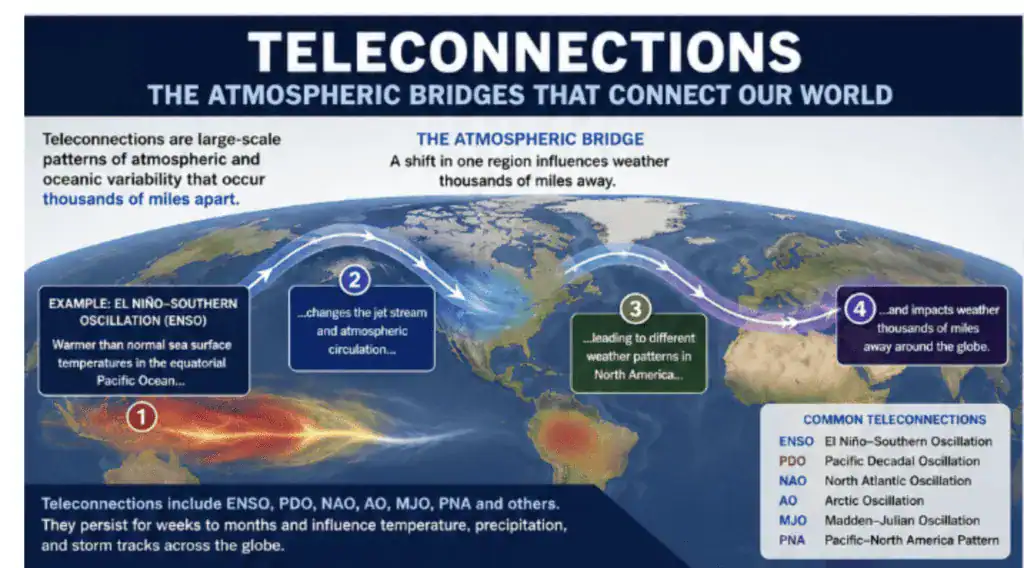
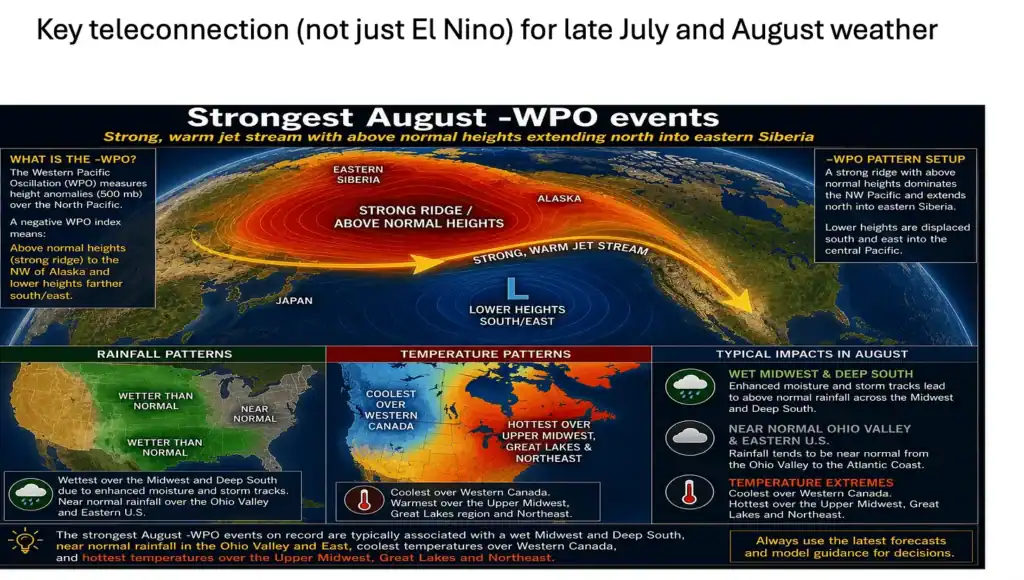
Jim Roemer caught the absolute lows in the coffee market last June anticipating some of the wettest Brazil harvest weather in decades. However, we forecasted 8 months ago that Brazil’s overall crop to be very large, creating a potentially bearish influence once that coffee reaches the market. We used teleconnections in 2025, such as a weak La Niña and a very negative Antarctic Oscillation index (-AAO) to predict last September, a big rebound in Brazil’s coffee production.
On the other hand, arabica inventories are unusually tight.
This has contributed to enormous market volatility.
ICE-certified arabica inventories have fallen to roughly 242,000 bags, a 2½-year low.
Low exchange stocks make the market more sensitive to disruptions.
For colombian coffee, there is less readily deliverable inventory as a buffer.
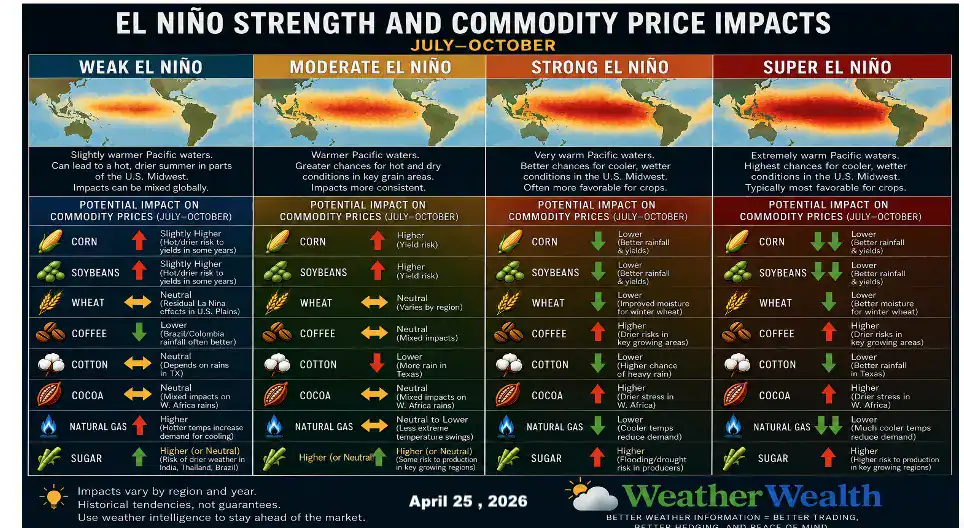
So while short term, coffee prices may have peaked and could be under pressure. What do strong El Niño events imply for prices later this year for coffee, sugar, cocoa, corn, soybeans and natural gas?
What about the grain market? There is an important USDA report today.
Paid subscribers find out about El Niño strength and its impact on certain commodity futures, below.
To upgrade your subscription for specific trading ideas, etc., you can “check us out” and request a complimentary 2-week trial to WeatherWealth:
We appreciate your interest and look forward to helping you gain a better understanding of the powerful connection between weather and global commodity markets.
Thanks for your consideration in joining our followers.
Mr. Roemer owns Best Weather Inc., offering weather-related blogs for commodity traders and farmers. He is also a co-founder of Climate Predict, a detailed long-range global weather forecast tool. As one of the first meteorologists to become an NFA-registered Commodity Trading Advisor, he has worked with major hedge funds, Midwest farmers, and individual traders for over 35 years. With a special emphasis on interpreting market psychology, coupled with his short and long-term trend forecasting in grains, softs, and the energy markets, he commands a unique standing among advisors in the commodity risk management industry.
Straight from Doctor Weather’s mouth… you need to read this, if it affects you positively or negatively
by Scott Mathews
Editor-in-Chief and Co-Producer of Climatelligence
August 3, 2026
Source: Jim Roemer – Meteorologist – Commodity Trading Advisor – Principal, Best Weather Inc. & Climate Predict – Publisher, Weather Wealth Newsletter and Co-Producer of Climatelligence
Comments below are by Jim Roemer:
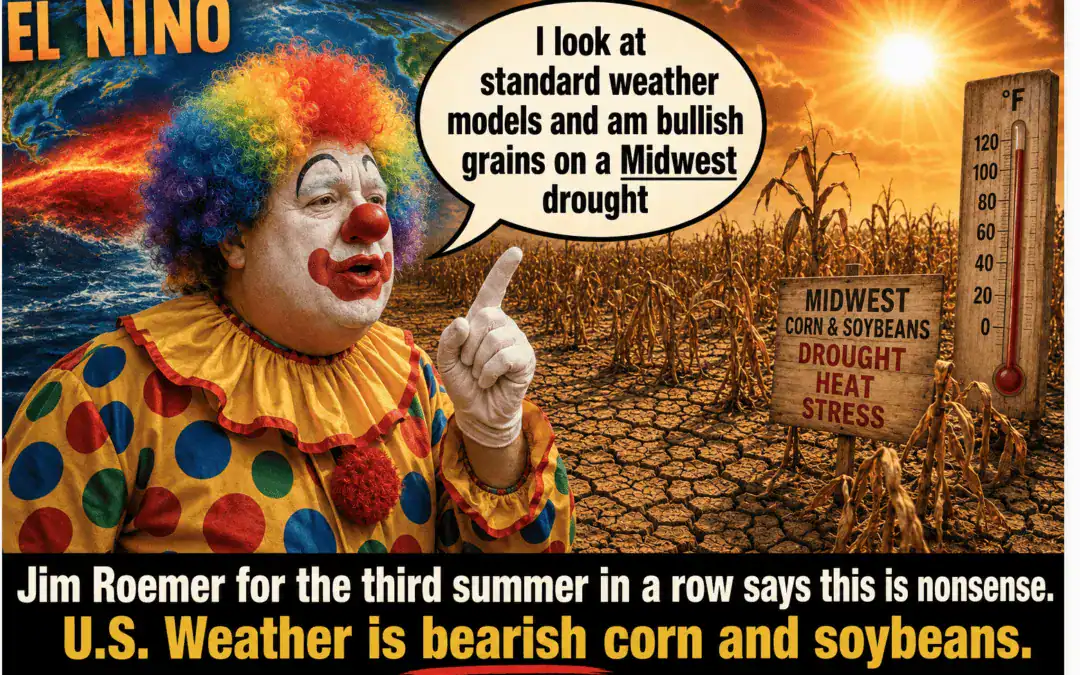
This is the most important time of the year for Midwest corn and soybeans. Throughout August, there will be several chances of rain, with no major sustained heat across the region, and the timing of showers will vary by location, which makes local observation valuable for crop planning.
I expect several opportunities for rain in key areas and have not trusted standard weather models, once again this summer. This pattern could influence yields differently by field, so monitoring local forecasts remains essential for farmers.
Rains, I predicted from last week, in Iowa this past Friday morning “against” standard weather models that changed a few days ago. Off-and-on chances for rain will dot key areas of the Midwest well into August. This is in contrast to some advisory firms and several meteorologists “out there” (who have never traded commodity futures).
See my videos from earlier this week.
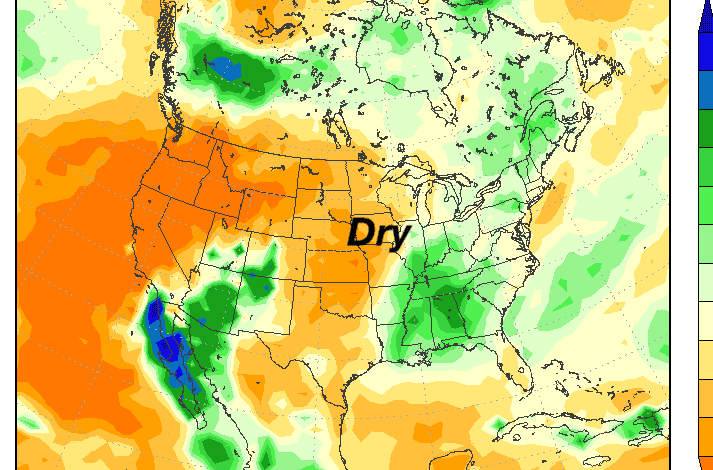
Last week’s weather models for the period of early-to-mid August.
I disagreed two weeks ago when corn and soybean prices began soaring. To make forecasts, I use teleconnections, not standard weather models
Models a week or two ago (above) were dry for much of the corn belt. Even so, I did not get caught up in the bullish hype. I was not worried for 70% of the region, only the western areas.
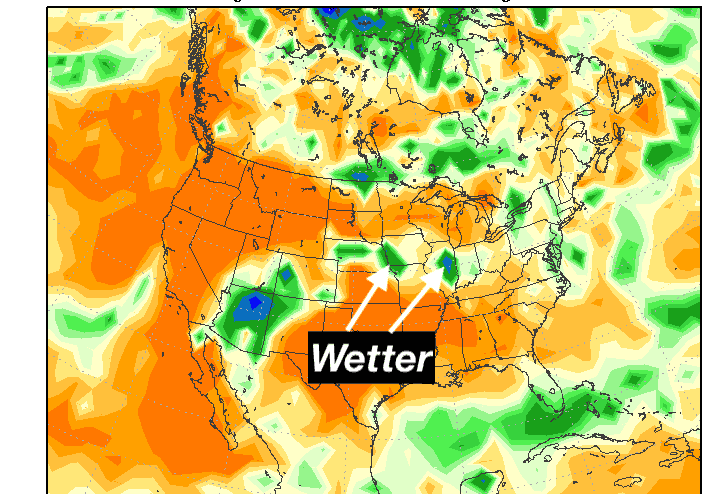
Recently, I mentioned a ”ring of fire” (not the great Johnny Cash song). Please don’t get caught up in the baloney hype of lower US corn and soybean yields. Notice (below) how weather models changed. For early to mid-August, I predicted it would be wetter.
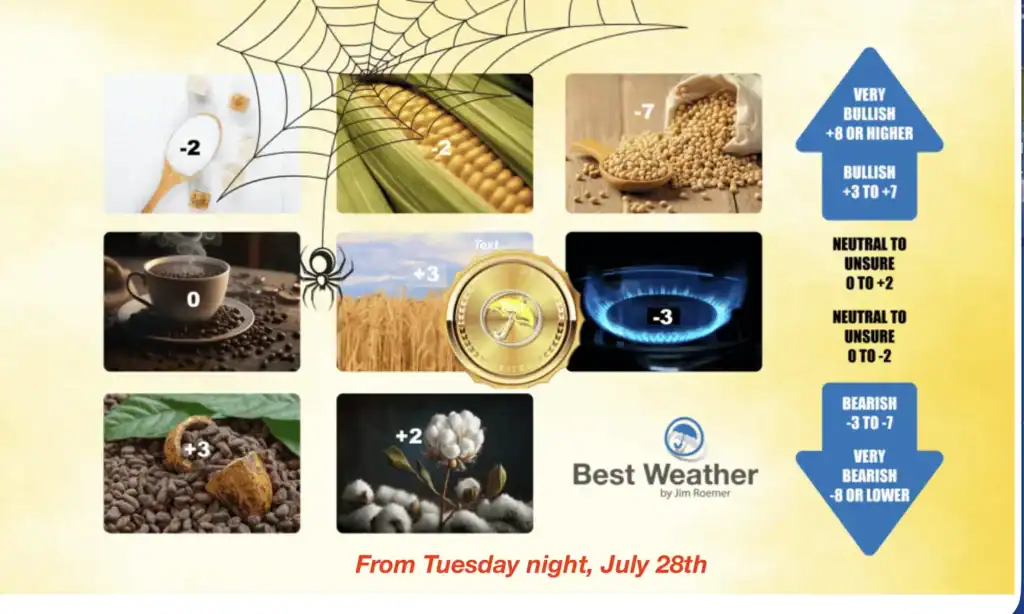
For paid Climatelligence subscribers: find our updates below and our weather Spider trade sentiment report we sent to Best Weather’s premium WeatherWealth Clients last week.
Comment from Scott Mathews:
Jim Roemer was most bullish toward cotton prices based on the charts, tight global inventories, and weather problems in Texas and Oklahoma.
He became bearish about soybeans (too early) two weeks ago, in the midst of hype over Midwest crop problems and higher crude prices, due to the war. Our Spider became more bearish 30-40¢ higher than it is now (between -7 to -10) several days ago.
Will coffee prices rally back if it gets wet? For that, please subscribe to our premium WeatherWealth newsletter with more frequent trading strategies:
We appreciate your interest and look forward to helping you gain a better understanding of the powerful connection between weather and global commodity markets.
Thanks for your consideration in joining our followers.
Mr. Roemer owns Best Weather Inc., offering weather-related blogs for commodity traders and farmers. He is also a co-founder of Climate Predict, a detailed long-range global weather forecast tool. As one of the first meteorologists to become an NFA-registered Commodity Trading Advisor, he has worked with major hedge funds, Midwest farmers, and individual traders for over 35 years.
With a special emphasis on interpreting market psychology, and with short- and long-term trend forecasting in grains, softs, and the energy markets, he commands a unique standing among advisors in the commodity risk management industry, including corn, in the U.S. and globally.
El Niño and the wars are creating inflationary concerns in some commodity markets.
by Scott Mathews
Editor-in-Chief and Co-Producer of Climatelligence
July 24, 2026, Source: Jim Roemer – Meteorologist – Commodity Trading Advisor – Principal, Best Weather Inc. & Climate Predict – Publisher, Weather Wealth Newsletter and Co-Producer of Climatelligence
The first bull market wheat traders have seen in years.
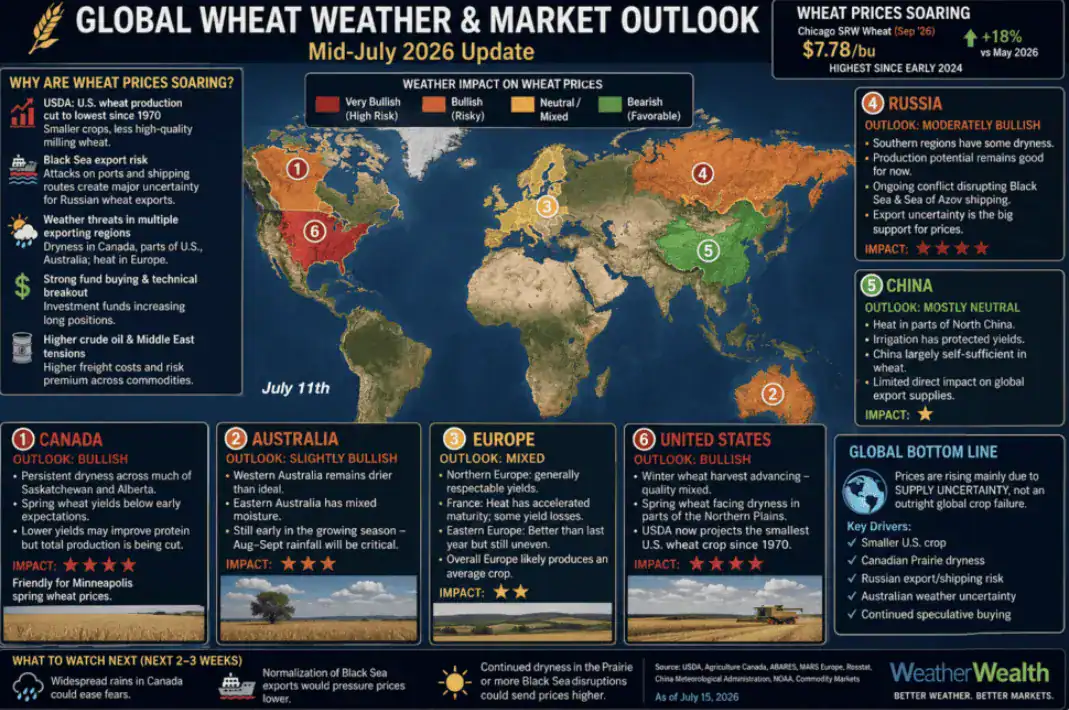
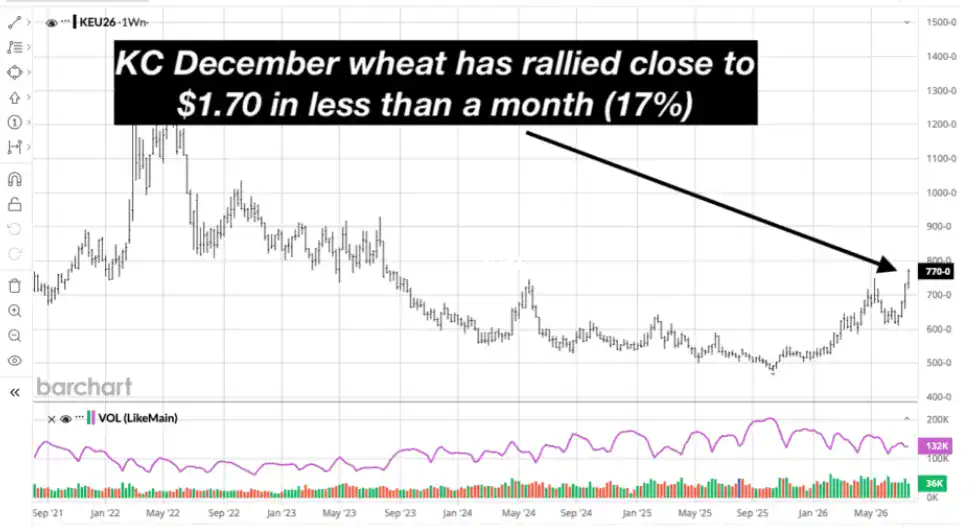
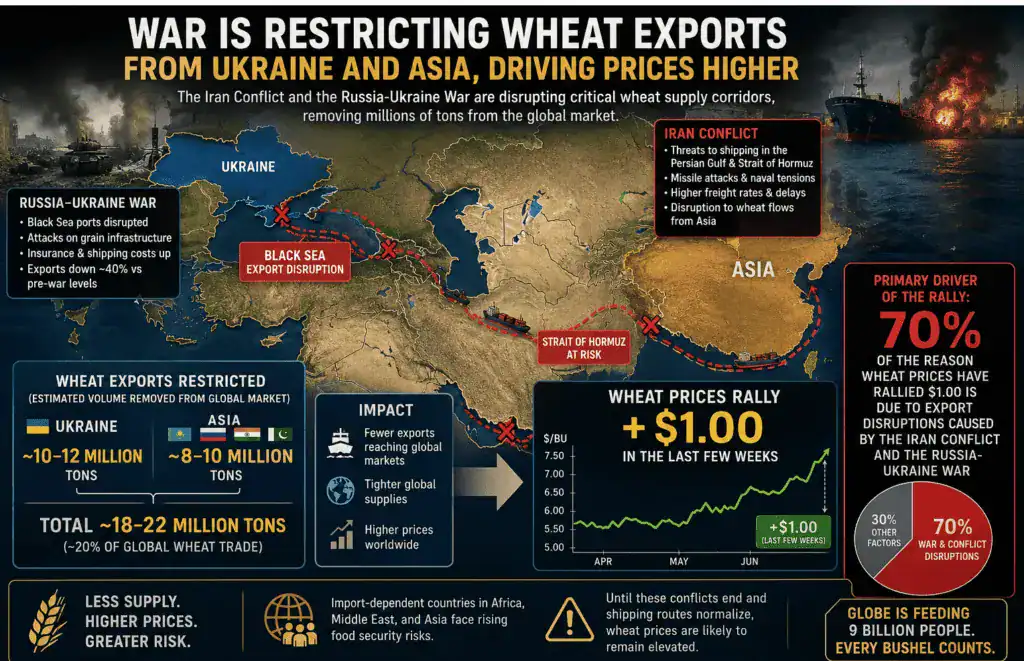
El Niño and the wars are creating inflationary concerns in some commodity markets. Below is a description of why wheat’s price has soared over the last few weeks.
Image Source: Barchart.com with commentary by Best Weather, Inc.
Question:
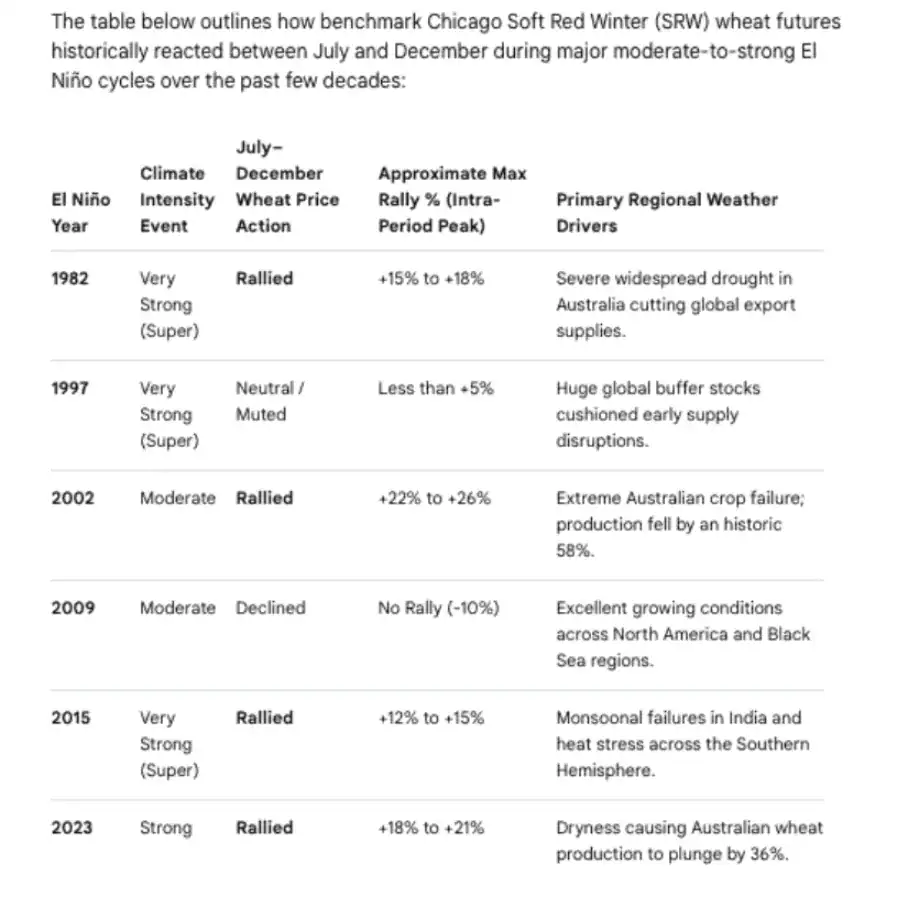
How often has the price of wheat futures rallied from July through December, during moderate or strong El Niño events?
Answer:
About 70% of the time, wheat prices have rallied by an average of 14%.
What is driving THIS bull market?
We know WHO is leading the charge…
… but WHY* ???
*The wars overseas and the lack of exports coming out of the Middle East and Ukraine
Big time heat in Europe and the northern Plains spring wheat areas: While the main growth stages of wheat are now over, reductions in both wheat crops (France and the Dakotas) are still occurring due to these extreme temperatures.
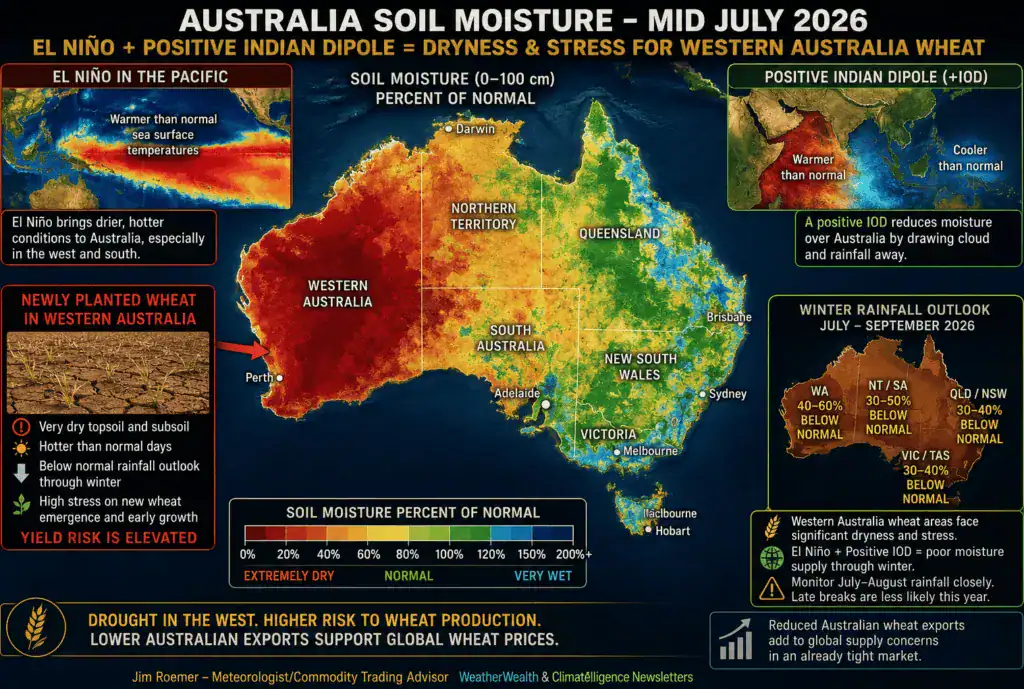
Dryness in Australia’s west, El Niño, and a positive Indian Ocean Dipole (IOD) are impeding the wheat crop. While much of New South Wales and Queensland in eastern regions received important spring rains for planting, the western areas are at risk for crop losses.
The lowest US wheat crop since the early 1960s: The drought in the Plains last spring and lower acreage are creating a squeeze in the market. Millers and food processors in the United States are scrambling.
SO WHAT SHOULD YOU DO IN THE WHEAT MARKET? Should you buy the Wheat ETF (WEAT), outright futures, selected calendar spreads, or options?
Jim Roemer’s answer (for Climatelligence’s paid subscribers) is below:
I do not like buying markets that are partly related to war. Plus, when everyone jumps into a market, that is often the time to sell. I have advised global clients in my popular premium WeatherWealth newsletter to hedge some of their 2026-27 wheat crop at these prices.
Most recently, I felt that coffee prices would tank, and at this point, I advised some traders who sold call options to take nice profits and go on the sidelines.
If one really wants to trade wheat, the best suggestion is to wait for a break of at least 10-20 cents and then potentially buy the ETF (WEAT) and to risk only 5%.
We appreciate your interest and look forward to helping you gain a better understanding of the powerful connection between weather and global commodity markets.
Thanks for your consideration in joining our followers.
Mr. Roemer owns Best Weather Inc., offering weather-related blogs for commodity traders and farmers. He is also a co-founder of Climate Predict, a detailed long-range global weather forecast tool. As one of the first meteorologists to become an NFA-registered Commodity Trading Advisor, he has worked with major hedge funds, Midwest farmers, and individual traders for over 35 years. With a special emphasis on interpreting market psychology, coupled with his short and long-term trend forecasting in grains, softs, and the energy markets, he commands a unique standing among advisors in the commodity risk management industry.
Would you like to know what we think will happen to corn and soybean prices? (Paid subscribers find out our sentiment – so now is your opportunity to sign up!)
by Scott Mathews , Editor-in-Chief
Source: Jim Roemer – Meteorologist – Commodity Trading Advisor – Principal, Best Weather Inc. & Climate Predict – Publisher, Weather Wealth Newsletter and Climatelligence
Climatelligence is produced by Mr. Roemer and Mr.Mathews.
July 10, 2026
Welcome to Climatelligence! Our Substack publication is an abbreviated version of our Weather Wealth newsletter, a popular source of actionable commodity trading recommendations sent to farmers, hedgers, investors, and folks like you on six continents.
To find out more about our global agricultural and energy weather forecast and market outlook, please upgrade below. (If you are already a Climatelligence subscriber, you can access our full report here.)
What will happen to corn and soybean prices?
(Paid subscribers find out our sentiment)
Strong El Niño events tend to produce decent U.S corn and soybean crops. While there will be some extreme heat over 30% of the western Midwest grain belt before July 15th, it will likely not last. It is rare, however, to see 4 consecutive years of back-to-back record corn and soybean crops. Hence, my confidence being too bearish is not as high as it was last summer and the summer before that.
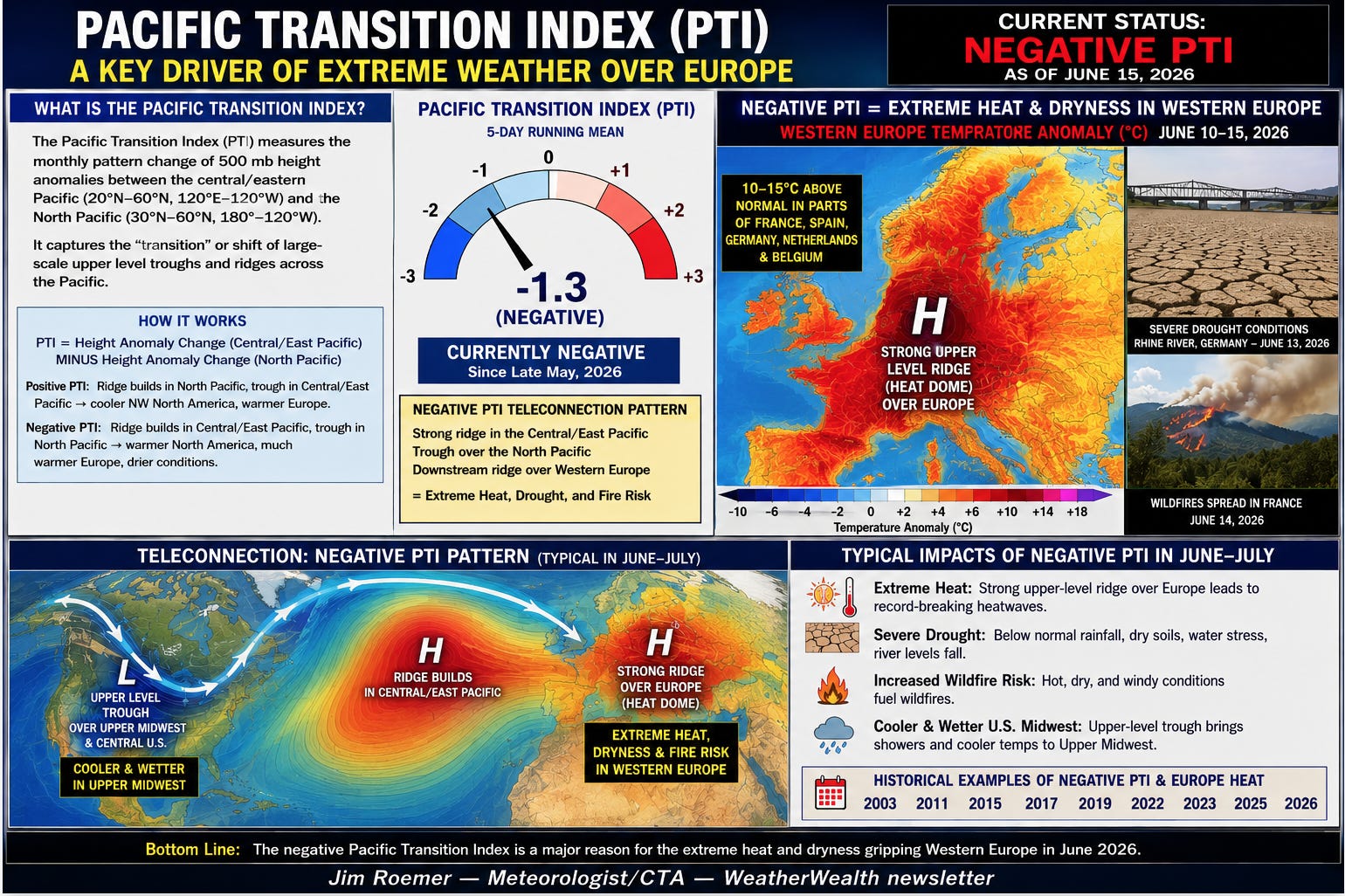
One key teleconnection other than El Niño is the PTI index (shown below). Other meteorologists rarely look at this. The result should be a neutral-to-bear market in corn and soybeans this summer. This means that one would sell out-of-the-money call options or buy December puts and/or November soybeans. I would say the odds are 60% that both corn and soybean prices have 10% more to fall unless something changes in the next few weeks.
We appreciate your interest and look forward to helping you gain a better understanding of the powerful connection between weather and global commodity markets.
Thanks for your consideration in joining our followers.
Mr. Roemer owns Best Weather Inc., offering weather-related blogs for commodity traders and farmers. He is also a co-founder of Climate Predict, a detailed long-range global weather forecast tool. As one of the first meteorologists to become an NFA-registered Commodity Trading Advisor, he has worked with major hedge funds, Midwest farmers, and individual traders for over 35 years. With a special emphasis on interpreting market psychology, coupled with his short and long-term trend forecasting in grains, softs, and the energy markets, he commands a unique standing among advisors in the commodity risk management industry.
HELPING YOU MAKE THE BEST INVESTMENT DECISIONS BASED ON THE WEATHER
We use cookies to ensure that we give you the best experience on our website. If you continue to use this site we will assume that you are happy with it.