
by Scott Mathews
Editor-in-Chief and Co-Producer of Climatelligence
- August 12, 2026
Source: Jim Roemer – Meteorologist – Commodity Trading Advisor – Principal, Best Weather Inc. & Climate Predict – Publisher, Weather Wealth Newsletter and Co-Producer of Climatelligence
Special Report
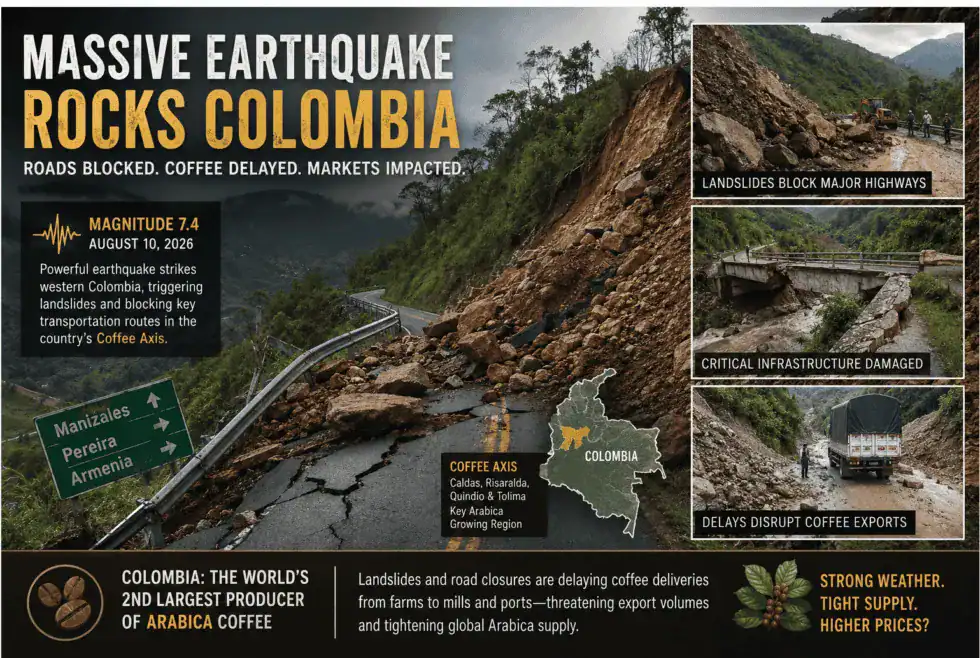
Colombia plays a key role in the global coffee market through its high-quality production of colombian coffee.
More importantly, though, Columbia ia the second-largest producer of arabica coffee after Brazil. Colombian production is almost entirely arabica, so disruptions there can have a disproportionate effect on the benchmark arabica market even though countries such as Vietnam produce large quantities of the robusta variety of coffee.
Colombia is forecast to produce roughly 13.4 million 60-kg bags in 2026/27, with exports also around 13.4 million bags. Its largest export market is the United States, followed by the EU and Japan.
Why the earthquake matters for colombian coffee
The 7.4-magnitude earthquake on August 10 is particularly relevant because it struck western Colombia, including areas close to the country’s important “CoffeeGrowing Axis” (Spanish: Eje Cafetero), which is a geographic, cultural, economic and ecological region of Colombia, located in the departments of Caldas, Risaralda and Quindío, as well as the regions of northwestern Tolima, northern and eastern Valle del Cauca and southwestern Antioquia,
Caldas and Risaralda account for roughly one-quarter of Colombian production, according to current commodity-market reporting.
The immediate market concern isn’t necessarily destroyed coffee trees. Logistics may be the bigger short-term problem. Coffee has to move from mountainous farms to mills and warehouses and then by truck toward export terminals. The earthquake damaged or blocked major transportation corridors, including the Buga–Buenaventura and Cali–Loboguerrero routes, while several regional airports have suspended operations.
Most importantly, terminal operations at Buenaventura, which handles a large share of Colombia’s coffee exports, have reportedly been temporarily suspended. Inland road closures and traffic restrictions could further interfere with cargo movements. Arabica futures responded to these concerns on August 11, reaching a five-week high in the nearest futures contract.
The key distinction is that this is currently primarily a logistical supply shock, rather than evidence that Colombia’s entire crop has been substantially reduced. The size and duration of the market effect will depend heavily on how quickly roads and port operations normalize.
Our premium WeatherWealth newsletter advised clients potentially selling into the massive coffee rally on Tuesday due to our forecast for improved Brazilian harvest pressure.
Brazil is arguably the biggest fundamental to watch. Brazil dominates global coffee production, and its 2026 harvest has been progressing more slowly than normal. Cooxupé members (the coffee growers’ co-operative) were about 67.3% harvested as of July 31 versus 74.2% a year earlier. That delay was supportive for prices in the short term.
Jim Roemer caught the absolute lows in the coffee market last June anticipating some of the wettest Brazil harvest weather in decades. However, we forecasted 8 months ago that Brazil’s overall crop to be very large, creating a potentially bearish influence once that coffee reaches the market. We used teleconnections in 2025, such as a weak La Niña and a very negative Antarctic Oscillation index (-AAO) to predict last September, a big rebound in Brazil’s coffee production.
On the other hand, arabica inventories are unusually tight.
This has contributed to enormous market volatility.
ICE-certified arabica inventories have fallen to roughly 242,000 bags, a 2½-year low.
Low exchange stocks make the market more sensitive to disruptions.
For colombian coffee, there is less readily deliverable inventory as a buffer.
So while short term, coffee prices may have peaked and could be under pressure. What do strong El Niño events imply for prices later this year for coffee, sugar, cocoa, corn, soybeans and natural gas?
What about the grain market? There is an important USDA report today.
Paid subscribers find out about El Niño strength and its impact on certain commodity futures, below.
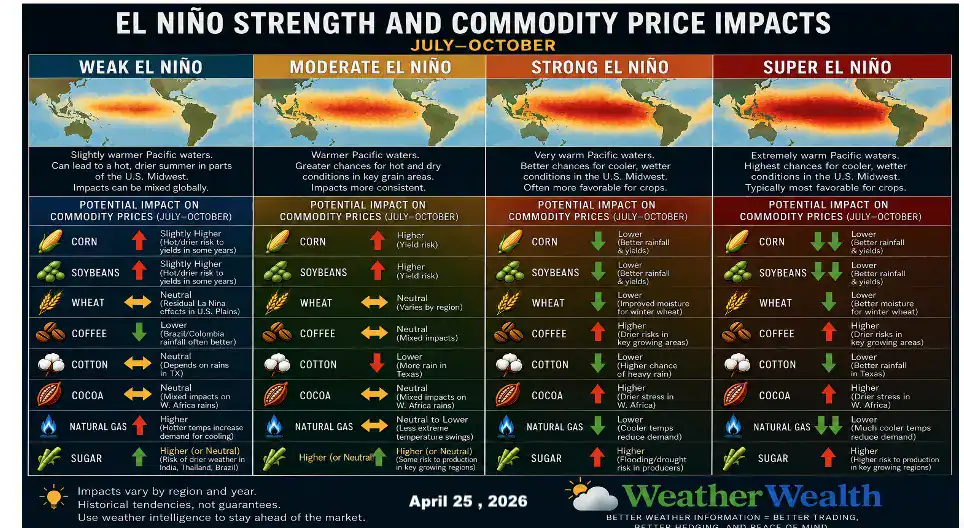
To upgrade your subscription for specific trading ideas, etc., you can “check us out” and request a complimentary 2-week trial to WeatherWealth:
To do so… just click here > > > > > https://www.bestweatherinc.com/register/
What’s next? For that, please subscribe to our premium WeatherWealth newsletter with more frequent trading strategies:
HERE https://www.bestweatherinc.com/new-membership-options/
We appreciate your interest and look forward to helping you gain a better understanding of the powerful connection between weather and global commodity markets.
Thanks for your consideration in joining our followers.
Jim Roemer, Scott Mathews, and the Best Weather Team
Mr. Roemer owns Best Weather Inc., offering weather-related blogs for commodity traders and farmers. He is also a co-founder of Climate Predict, a detailed long-range global weather forecast tool. As one of the first meteorologists to become an NFA-registered Commodity Trading Advisor, he has worked with major hedge funds, Midwest farmers, and individual traders for over 35 years. With a special emphasis on interpreting market psychology, coupled with his short and long-term trend forecasting in grains, softs, and the energy markets, he commands a unique standing among advisors in the commodity risk management industry.
