Editor-in-Chief and Co-Producer of Climatelligence
August 12, 2026
Source: Jim Roemer – Meteorologist – Commodity Trading Advisor – Principal, Best Weather Inc. & Climate Predict – Publisher, Weather Wealth Newsletter and Co-Producer of Climatelligence
Special Report
Colombia plays a key role in the global coffee market through its high-quality production of colombian coffee.
More importantly, though, Columbia ia the second-largest producer of arabica coffee after Brazil. Colombian production is almost entirely arabica, so disruptions there can have a disproportionate effect on the benchmark arabica market even though countries such as Vietnam produce large quantities of the robusta variety of coffee.
Colombia is forecast to produce roughly 13.4 million 60-kg bags in 2026/27, with exports also around 13.4 million bags. Its largest export market is the United States, followed by the EU and Japan.
Why the earthquake matters for colombian coffee
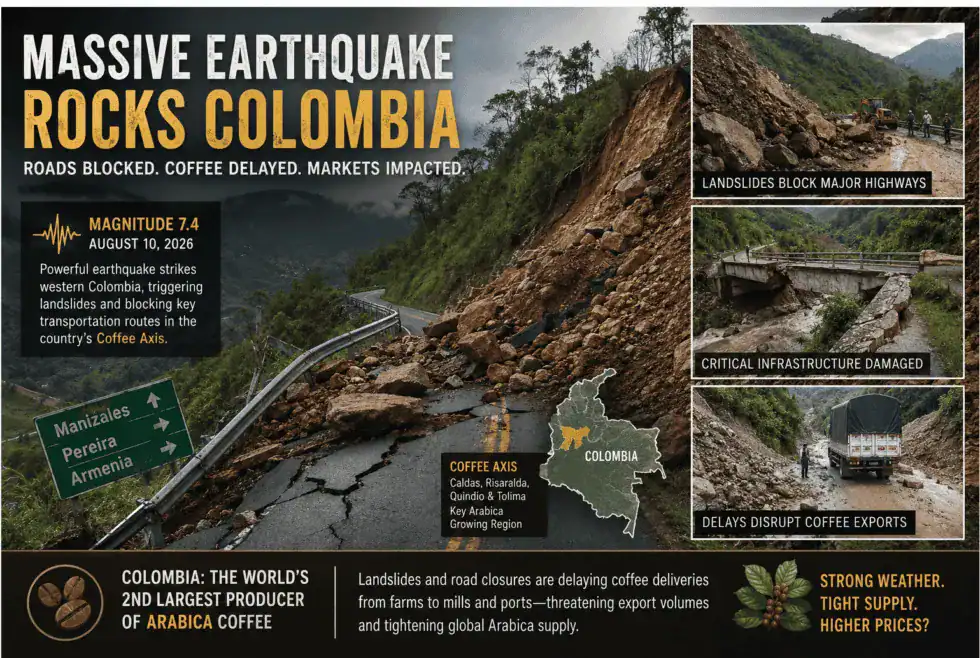
The 7.4-magnitude earthquake on August 10 is particularly relevant because it struck western Colombia, including areas close to the country’s important “CoffeeGrowing Axis” (Spanish: Eje Cafetero), which is a geographic, cultural, economic and ecological region of Colombia, located in the departments of Caldas, Risaralda and Quindío, as well as the regions of northwestern Tolima, northern and eastern Valle del Cauca and southwestern Antioquia,
Caldas and Risaralda account for roughly one-quarter of Colombian production, according to current commodity-market reporting.
The immediate market concern isn’t necessarily destroyed coffee trees. Logistics may be the bigger short-term problem. Coffee has to move from mountainous farms to mills and warehouses and then by truck toward export terminals. The earthquake damaged or blocked major transportation corridors, including the Buga–Buenaventura and Cali–Loboguerrero routes, while several regional airports have suspended operations.
Most importantly, terminal operations at Buenaventura, which handles a large share of Colombia’s coffee exports, have reportedly been temporarily suspended. Inland road closures and traffic restrictions could further interfere with cargo movements. Arabica futures responded to these concerns on August 11, reaching a five-week high in the nearest futures contract.
The key distinction is that this is currently primarily a logistical supply shock, rather than evidence that Colombia’s entire crop has been substantially reduced. The size and duration of the market effect will depend heavily on how quickly roads and port operations normalize.
Our premium WeatherWealth newsletter advised clients potentially selling into the massive coffee rally on Tuesday due to our forecast for improved Brazilian harvest pressure.
Brazil is arguably the biggest fundamental to watch. Brazil dominates global coffee production, and its 2026 harvest has been progressing more slowly than normal. Cooxupé members (the coffee growers’ co-operative) were about 67.3% harvested as of July 31 versus 74.2% a year earlier. That delay was supportive for prices in the short term.
Jim Roemer caught the absolute lows in the coffee market last June anticipating some of the wettest Brazil harvest weather in decades. However, we forecasted 8 months ago that Brazil’s overall crop to be very large, creating a potentially bearish influence once that coffee reaches the market. We used teleconnections in 2025, such as a weak La Niña and a very negative Antarctic Oscillation index (-AAO) to predict last September, a big rebound in Brazil’s coffee production.
On the other hand, arabica inventories are unusually tight.
This has contributed to enormous market volatility.
ICE-certified arabica inventories have fallen to roughly 242,000 bags, a 2½-year low.
Low exchange stocks make the market more sensitive to disruptions.
For colombian coffee, there is less readily deliverable inventory as a buffer.
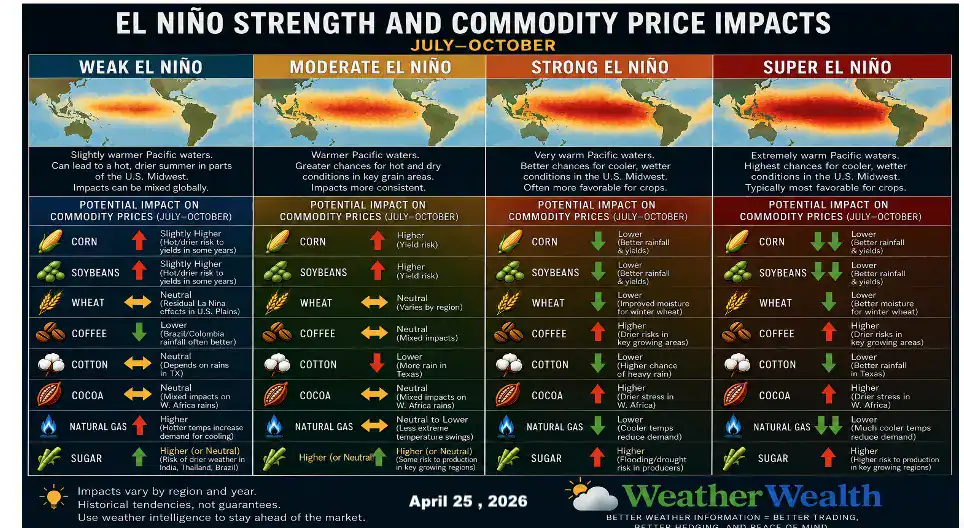
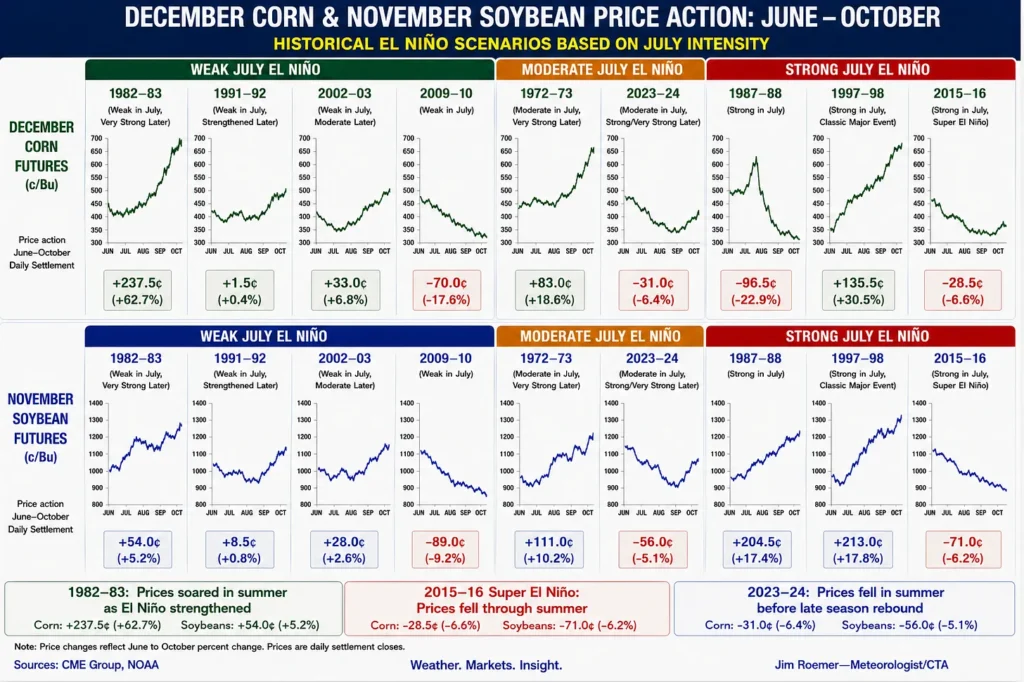
So while short term, coffee prices may have peaked and could be under pressure. What do strong El Niño events imply for prices later this year for coffee, sugar, cocoa, corn, soybeans and natural gas?
What about the grain market? There is an important USDA report today.
Paid subscribers find out about El Niño strength and its impact on certain commodity futures, below.
To upgrade your subscription for specific trading ideas, etc., you can “check us out” and request a complimentary 2-week trial to WeatherWealth:
We appreciate your interest and look forward to helping you gain a better understanding of the powerful connection between weather and global commodity markets.
Thanks for your consideration in joining our followers.
Mr. Roemer owns Best Weather Inc., offering weather-related blogs for commodity traders and farmers. He is also a co-founder of Climate Predict, a detailed long-range global weather forecast tool. As one of the first meteorologists to become an NFA-registered Commodity Trading Advisor, he has worked with major hedge funds, Midwest farmers, and individual traders for over 35 years. With a special emphasis on interpreting market psychology, coupled with his short and long-term trend forecasting in grains, softs, and the energy markets, he commands a unique standing among advisors in the commodity risk management industry.
Would you like to know what we think will happen to corn and soybean prices? (Paid subscribers find out our sentiment – so now is your opportunity to sign up!)
by Scott Mathews , Editor-in-Chief
Source: Jim Roemer – Meteorologist – Commodity Trading Advisor – Principal, Best Weather Inc. & Climate Predict – Publisher, Weather Wealth Newsletter and Climatelligence
Climatelligence is produced by Mr. Roemer and Mr.Mathews.
July 10, 2026
Welcome to Climatelligence! Our Substack publication is an abbreviated version of our Weather Wealth newsletter, a popular source of actionable commodity trading recommendations sent to farmers, hedgers, investors, and folks like you on six continents.
To find out more about our global agricultural and energy weather forecast and market outlook, please upgrade below. (If you are already a Climatelligence subscriber, you can access our full report here.)
What will happen to corn and soybean prices?
(Paid subscribers find out our sentiment)
Strong El Niño events tend to produce decent U.S corn and soybean crops. While there will be some extreme heat over 30% of the western Midwest grain belt before July 15th, it will likely not last. It is rare, however, to see 4 consecutive years of back-to-back record corn and soybean crops. Hence, my confidence being too bearish is not as high as it was last summer and the summer before that.
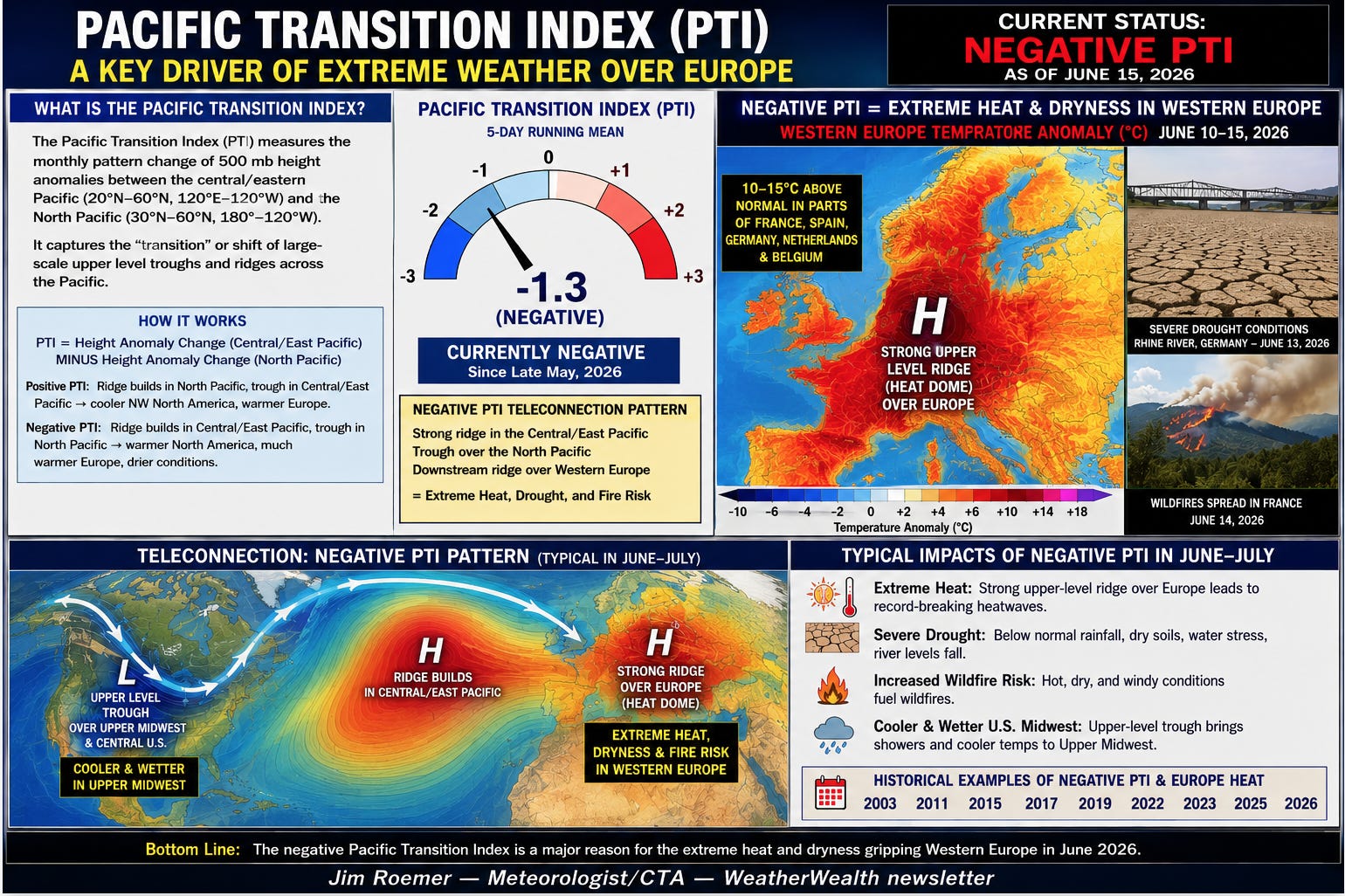
One key teleconnection other than El Niño is the PTI index (shown below). Other meteorologists rarely look at this. The result should be a neutral-to-bear market in corn and soybeans this summer. This means that one would sell out-of-the-money call options or buy December puts and/or November soybeans. I would say the odds are 60% that both corn and soybean prices have 10% more to fall unless something changes in the next few weeks.
We appreciate your interest and look forward to helping you gain a better understanding of the powerful connection between weather and global commodity markets.
Thanks for your consideration in joining our followers.
Mr. Roemer owns Best Weather Inc., offering weather-related blogs for commodity traders and farmers. He is also a co-founder of Climate Predict, a detailed long-range global weather forecast tool. As one of the first meteorologists to become an NFA-registered Commodity Trading Advisor, he has worked with major hedge funds, Midwest farmers, and individual traders for over 35 years. With a special emphasis on interpreting market psychology, coupled with his short and long-term trend forecasting in grains, softs, and the energy markets, he commands a unique standing among advisors in the commodity risk management industry.
In late May, I turned bearish on US corn while many traders remained focused on strong export demand and the potential geopolitical risk premium from the Middle East conflict. My view was that those bullish factors had already been largely priced into the market. What was being underestimated was the weather.
From a meteorological standpoint, the atmosphere was lining up for one of the most favorable spring planting seasons across much of the Corn Belt in years. Timely rainfall, adequate soil moisture, and the absence of prolonged flooding or planting delays allowed producers to make rapid planting progress. History shows that when crops get planted on time under favorable early-season conditions, yield potential increases significantly. Markets quickly shifted their attention away from geopolitical headlines and back toward the prospect of abundant US production.
What resulted was a sharp 10–15% decline in corn futures, exactly as I anticipated.
The next major catalyst arrives with the USDA Planted Acreage Report on June 30. If planted acreage exceeds expectations, the market could remain under pressure. However, if acreage comes in below expectations or if the report reveals fewer corn acres than traders currently anticipate, prices could stabilize or even rally.
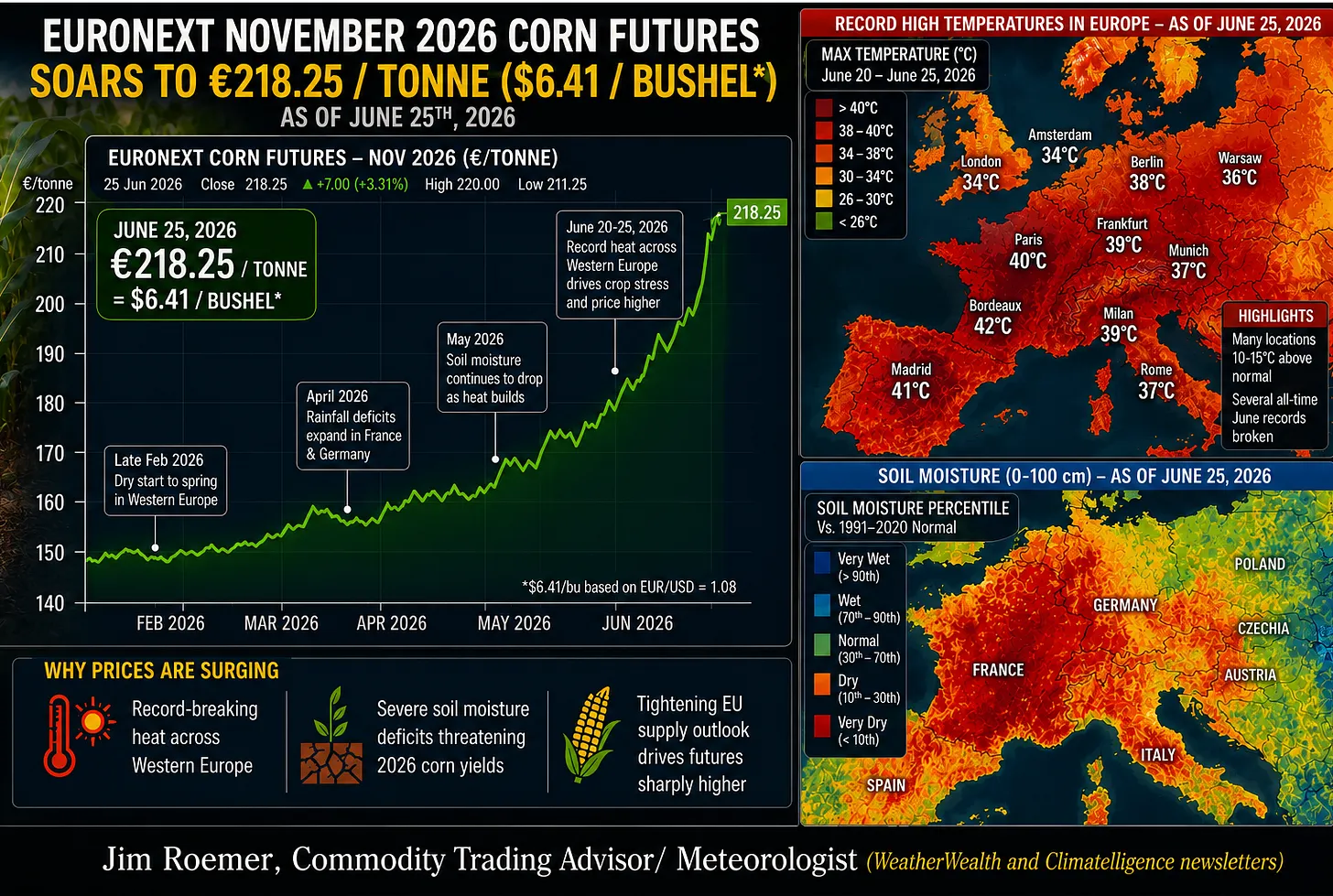
Another developing wildcard is Europe. An unusually intense early-summer heat wave is spreading across major agricultural regions, with temperatures exceeding 100°F (38°C) in parts of France, Spain, Italy, and the Balkans. Heat arriving this early in the growing season increases crop stress, particularly if accompanied by below-normal rainfall. European maize prices have already begun to climb as traders reassess production risks.
The key question now is whether Europe’s weather problems can offset the increasingly favorable US crop outlook. Corn markets often shift rapidly from local weather stories to global supply concerns. While the long-term US production outlook remains favorable, adverse weather in Europe—or later this summer in the US during pollination—could signal that corn has established an important seasonal bottom.
As always, weather remains the single most important variable determining grain prices. Understanding atmospheric patterns before they become widely recognized is often where the greatest market opportunities emerge.
To find out more about our global commodity weather forecast and market outlook, please upgrade below. (If you are already a Climatelligence subscriber, you can access our full report here.
What About El Niño?
Not all El Niño events have the same impact on US corn. Strong El Niño events often leave behind abundant spring soil moisture and, as they weaken into summer, tend to produce cooler and less stressful conditions across portions of the Midwest. This generally favors above-trend corn yields and can keep prices under pressure.
Weak El Niño events, however, are much less predictable. As they fade, the atmosphere can become more volatile, increasing the risk of summertime heat ridges and localized drought during the critical pollination period in July. In those years, weather markets can quickly add a significant risk premium to corn prices.
For farmers, the decision to hedge depends on both weather risk and current price levels. After the recent decline in corn prices and with excellent crop conditions across much of the Corn Belt, many producers may want to consider incremental hedges—particularly if the USDA’s June 30 acreage report confirms a large planted crop. However, maintaining some upside flexibility is also prudent. Weather during pollination remains the single most important determinant of final yields, and a shift toward hot, dry conditions could trigger a sharp summer rally.
The bottom line: favorable weather has driven prices lower, but the weather market is far from over. July remains the most important month for determining whether this year’s crop fulfills its yield potential—or surprises the market. Some heat is likely next month, but I am not convinced we are looking at a major drought that would result in a massive bull market, such as what is currently happening in the European market.
We appreciate your interest and look forward to helping you gain a better understanding of the powerful connection between weather and global commodity markets.
Mr. Roemer owns Best Weather Inc., offering weather-related blogs for commodity traders and farmers. He is also a co-founder of Climate Predict, a detailed long-range global weather forecast tool. As one of the first meteorologists to become an NFA-registered Commodity Trading Advisor, he has worked with major hedge funds, Midwest farmers, and individual traders for over 35 years. With a special emphasis on interpreting market psychology, coupled with his short and long-term trend forecasting in grains, softs, and the energy markets, he commands a unique standing among advisors in the commodity risk management industry.
As a veteran in the commodity futures industry, Scott’s career has taken him from learning the business on Continental Grain’s New York trading floor and later co-directing Citicorp’s entry into the energy commodity business in the bank’s brokerage subsidiary Citicorp Futures Corporation.
As an early participant in the weather derivatives market, Scott consulted and advised the Chicago Mercantile Exchange in designing and launching the first weather-indexed futures contracts for temperature, precipitation, and hurricanes. For nine years, he produced Weather to Buy or Sell– a feature that appeared in the weekly edition of The Wall Street Journal. This “infomercial” covered the CME weather futures activity.
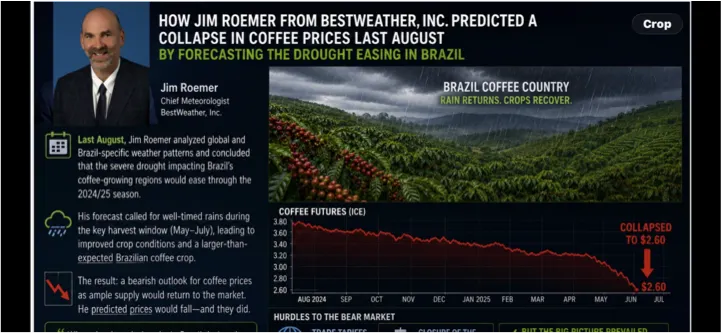
The illustration above reflects Mr. Roemer’s view in October of 2025 that Brazil’s coffee production would rebound and that we would enter a longer-term bear market.
Following back-to-back droughts and frost scares from 2023-2024 with surging coffee and cocoa prices, the coffee market fell back to earth. While some folks have felt that Brazil’s record crop could mean prices below $2 per pound, we have disagreed. These are the same traders who, at $3.50/lb. last year, were still bullish. They did not anticipate that a weak La Niña at the time would increase (not decrease) global coffee supplies.
Trade tariffs (the US war on Iran aside) had created incredible market volatility, and when Brazil’s record crop hit the market, prices fell below $2.50 a couple of weeks ago. Since that time, our view has been that disease issues from too much rain would hit key areas of Brazil. This caused us to recommend some cautiously bullish trade strategies for our subscribers. Coffee prices have since rallied 10% in the last few weeks.
To find out more about our global coffee weather forecast and market outlook, please upgrade below. (If you are already a Climatelligence subscriber, you can access our full report here.
More wet weather is coming for Brazil’s coffee crop – How El Niño may affect prices
Brazil’s coffee shifted from record-crop optimism to supply-risk concern.
Early on, traders expected a big 2025/26 Brazilian crop. This was because Arabica was in a favorable biennial cycle, and Robusta output was looking strong. That raised the hopes that global coffee supplies would loosen.
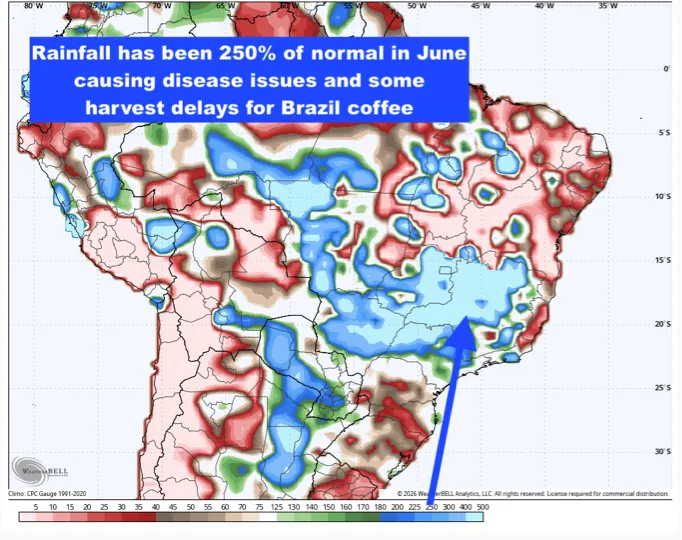
By June, the worry changed from too little rain to too much rain.Wet, cooler weather slowed harvesting, delayed ripening, limited fieldwork, and raised fears about bean quality.
We alerted our subscribers to this two weeks ago… and that it was likely that “the lows were in” for coffee prices.
Map Source: WeatherBELL
The rain also increased concern about fungal disease and pest pressure, including leaf rust, cercospora, and coffee borer issues.
Because global coffee inventories were already tight, even a modest threat to Brazil’s harvest triggered a strong market reaction.
The core narrative became:
→ big crop expected
→ weather damage trims potential
→ June rains threaten harvest pace and quality
→ prices rise on renewed supply fears.
We looked for a return of wet weather for the remainder of June to cause additional new concerns for Brazilian coffee.
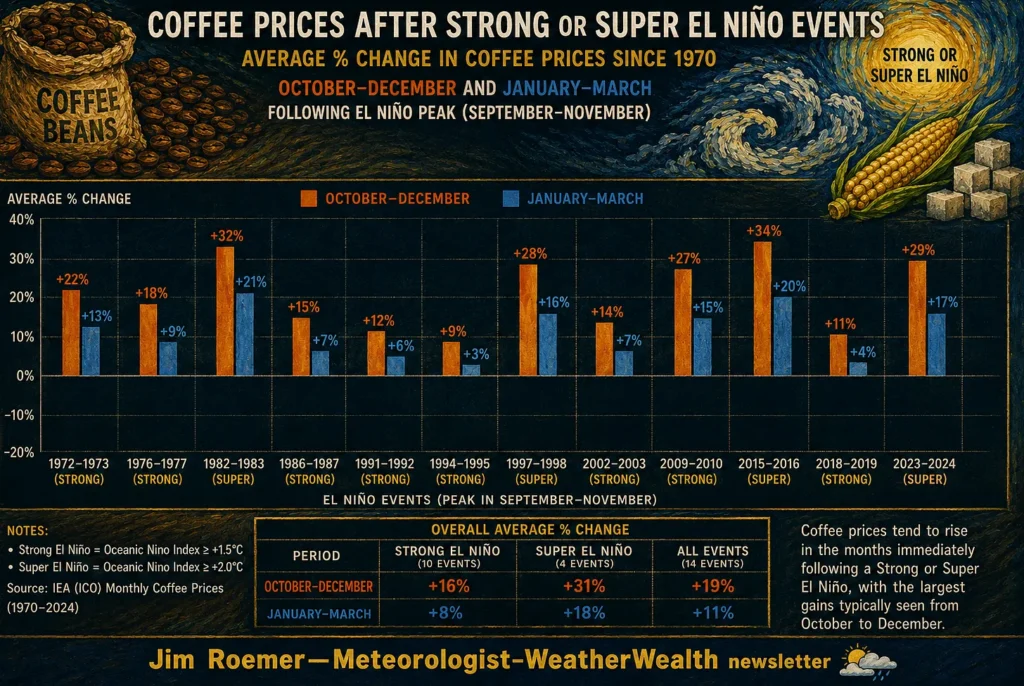
So… what about a longer view of coffee’s price? Well, just looking at El Niño events below, we can see how prices tend to go higher. Although Jim sees no frost potential for Brazil, a return of wet weather means prices should trend higher heading into July.
Image Source: WeatherWealth Newsletter
We appreciate your interest and look forward to helping you gain a better understanding of the powerful connection between weather and global commodity markets.
Thanks for your consideration in joining our followers.
Jim Roemer, Scott Mathews, and the Best Weather Team
Mr. Roemer owns Best Weather Inc., offering weather-related blogs for commodity traders and farmers. He is also a co-founder of Climate Predict, a detailed long-range global weather forecast tool. As one of the first meteorologists to become an NFA-registered Commodity Trading Advisor, he has worked with major hedge funds, Midwest farmers, and individual traders for over 35 years. With a special emphasis on interpreting market psychology, coupled with his short and long-term trend forecasting in grains, softs, and the energy markets, he commands a unique standing among advisors in the commodity risk management industry.
WEATHER WEALTH SAMPLE CONTENT
HELPING YOU MAKE THE BEST INVESTMENT DECISIONS BASED ON THE WEATHER
We use cookies to ensure that we give you the best experience on our website. If you continue to use this site we will assume that you are happy with it.