
Watch my video (above) about the melting Polar Vortex, the record-warm winter, and collapsing natural gas prices.
Worried about losing one second of time? The melting Polar Vortex is not only creating more and more of a warming planet but is speeding up the earth. Jim Roemer’s video (above) talks about how he predicted another warm winter, the collapse in natural gas prices, and which analog years might help predict summer grain markets and crops. Enjoy
Anyway, in the next couple of years, we’ll all lose one second of our day. It may not seem like much, but this tiny adjustment to our clocks is being impacted by the massive melting of polar ice due to climate change.
The length of our days is determined by the Earth’s rotation speed. As that spin gradually changes based on the planet’s surface and molten core shifts, we occasionally need to add or subtract a “leap second” to stay in sync.

While we’ve added plenty of extra seconds over time as the rotation slowed, the Earth is now speeding up again. For the first time, we’ll need to remove a second instead of adding one. However, the unprecedented removal could create unforeseen issues for computing systems used to only add time.
The kicker? This leap-second subtraction was originally forecasted for 2026 based on the accelerating spin. However, the study shows the melting ice caps are enough to delay that milestone day of lost time until 2029. A tiny difference, but one more stark reminder of the profound impact human-caused global warming has on the fundamental systems that govern our world.
In just a couple of years, we’ll need to remove a second from our clocks – something that’s never been done before. And the surprising reason? Human-caused polar ice melt.
While the slowing effect of tides has dominated Earth’s rotation changes historically, the melting ice sheets are now a major factor speeding up our planet’s spin. As that ice shifts from the poles towards the equator, it’s causing the entire Earth to rotate faster, like a figure skater pulling in their arms.
However, another force in the planet’s core is outweighing even the ice melt acceleration right now. We don’t fully understand these mysterious core processes 1,800 miles below, but they inexplicably spin up the solid outer shell independent of the liquid core’s motion.
The net result is an increasingly sped-up rotation requiring that unprecedented “leap second” subtraction soon, likely in 2026 according to the study. It’s a seemingly minuscule adjustment, but one with huge implications for things like stock exchanges and computing systems only designed to add time, never remove it.
To me, it’s astounding that human activities like burning fossil fuels have now measurably altered something as fundamental as the literal spin of our entire planet on its axis. A stark reminder of our growing impacts.
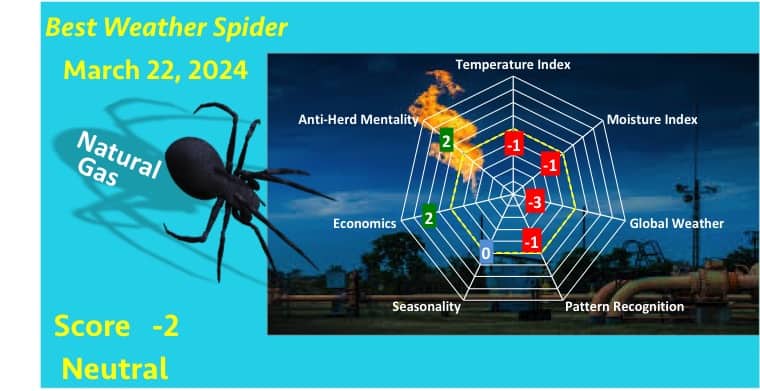
When it comes to commodities, One of the impacts has of course been the collapse in natural gas prices once again. Selling natural gas in the fall and getting out in the early spring has worked “almost every time” in the last few years. My spider, which was firmly bearish at a -8 back in December, is a bit more neutral now at these prices, but I see nothing to get excited about in this market given such massive global supplies.
WeatherWealth has spiders such as this, each week from cocoa and coffee to corn, soybeans, and more.
As we head towards the spring and summer weather markets in grains and soft commodities, find out how to trade better, get a jump ahead of other weather forecast firms with a 2-week free trial period to WeatherWealth, here

